







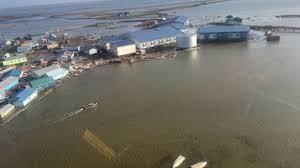
1 Dead, 2 Missing as Typhoon Remnants Devastate Western Alaska
JUNEAU (US): One person was confirmed dead and two others remained missing in western Alaska on Monday after the remnants of Typhoon Halong battered the region over the weekend, bringing hurricane-force winds, massive storm surges, and flooding that swept away homes, officials said.
More than 50 people were rescued — some airlifted from rooftops — as authorities warned of a long recovery ahead, with winter fast approaching. “Absolute devastation,” is how US Coast Guard Capt. Christopher Culpepper described the situation in the villages of Kipnuk and Kwigillingok.
Elsewhere in the US, severe weather also claimed lives and disrupted events. In New York City, a woman was killed when she was struck by a falling solar panel, forcing the cancellation of the Columbus Day Parade. In Arizona, rescuers found a man’s body after his truck was swept away by floodwaters near Phoenix, while southern California crews braced for potential mudslides in wildfire-scorched areas.
Alaska Villages Reeling from Storm’s Impact
Alaska State Troopers said at least 51 people and two dogs were rescued in Kipnuk and Kwigillingok after the storm unleashed heavy flooding and powerful surges. A woman was found dead in Kwigillingok, and two people remained missing. Earlier fears of additional missing residents in Kipnuk were later dismissed.
Most residents in the two communities took refuge in local schools, according to the Coastal Villages Region Fund. Many reported power outages, contaminated water supplies, spoiled food stores, and damage to home-heating stoves — a critical blow with freezing temperatures nearing.
“These losses will make the coming winter extremely difficult,” said a local aid worker, noting that residents rely on stored subsistence foods from hunting and fishing to survive the season.
‘The Worst I’ve Ever Seen’
Jamie Jenkins, 42, from the nearby village of Napakiak, said the storm was unlike anything she had experienced. “The winds were howling, and the water kept rising,” she said. As her mother’s house shifted on its foundation and her neighbor’s flooded, the three evacuated by boat to the school, where much of the community had gathered.
Men in the village used boats to rescue others still stranded in their homes. In Kotlik, another affected community, resident Adaline Pete said the winds were so strong they flipped a nearby unoccupied house. “We were scared, but we felt safe inside,” she said.
Senators Push for Climate Resilience Funding
At a briefing with Governor Mike Dunleavy, Alaska’s Republican Senators Lisa Murkowski and Dan Sullivan pledged continued efforts to secure federal funds for recovery and climate resilience.
Sullivan emphasized the importance of ensuring the Trump administration and Congress understood Alaska’s unique vulnerabilities. Murkowski added that erosion and climate projects take years to complete, urging faster action.
“Our reality is that these storms are hitting more frequently and more intensely,” she said. “The time to act is now.”
Kwigillingok, home to about 380 residents, lies on the low-lying western shore of Kuskokwim Bay. A 2022 report by the Alaska Institute for Justice warned that worsening floods and erosion had made relocation an urgent necessity.
Climate Challenges Deepen
Erosion, melting permafrost, and stronger storms continue to threaten entire communities in Alaska, one of the regions most visibly impacted by climate change. Many villages are already planning relocations as rising seas and unstable ground erode the land beneath them.
California Braces for Mudslides
In California, emergency crews with helicopters and bulldozers were positioned near wildfire burn zones ahead of a powerful storm expected to unleash heavy rain. A flood watch was issued for much of Southern California through Tuesday, with several inches of rain forecast and up to three feet of snow predicted for parts of the Sierra Nevada.
Arizona Hit by Intense Microburst
In Arizona, a sudden microburst struck Tempe on Monday, dropping half an inch of rain in 10 minutes. Meteorologist Katherine Berislavich said such bursts — when a storm collapses and expels air at high speed — can cause tornado-like destruction.
The storm uprooted trees, tore roofs off buildings, and left thousands without power. Streets turned into rivers as parking lots and dry washes flooded across the region.