






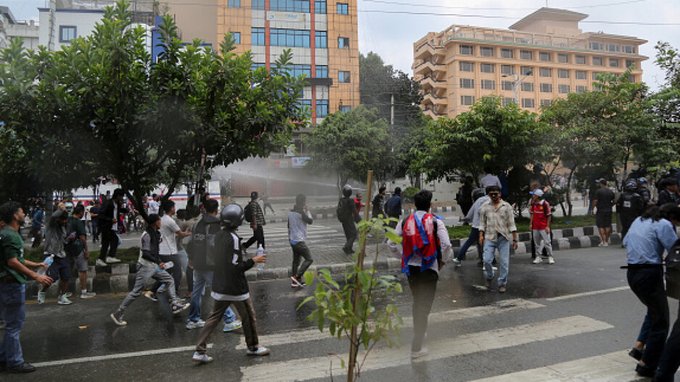
KATHMANDU: At least 19 people were killed and over 300 injured on Monday as police clashed with youth protesters in Nepal over a government ban on social media, officials said.
Thousands of young people, including school students, gathered under the banner of Gen Z in front of the Parliament in central Kathmandu, demanding the immediate lifting of the ban. Protests spread to Pokhara, Butwal, Bhairahawa, Bharatpur, Itahari, and Damak.
Nepal Police spokesperson Binod Ghimire reported that 17 people died in Kathmandu during clashes, while two more were killed in Sunsari district in eastern Nepal following police firing.
Home Minister Ramesh Lekhak of the Nepali Congress resigned on moral grounds, sources said. The Nepali Army was deployed in Kathmandu as tensions escalated, taking control of roads around the Parliament complex in New Baneshwor.
Eyewitnesses said violence erupted when some protesters entered the Parliament premises, prompting police to use water cannons, tear gas, and live ammunition. According to hospital sources cited by The Kathmandu Post, eight people died at the National Trauma Centre, three at Everest Hospital, three at Civil Hospital, two at Kathmandu Medical College, and one at Tribhuvan Teaching Hospital.
The Ministry of Health reported that at least 347 injured protesters are being treated nationwide, including 100 at Civil Hospital, 102 at Everest Hospital, 59 at Trauma Centre, and others across multiple facilities. The Himalayan Times said hospitals are struggling to accommodate patients and are referring some to other centers.
Following the unrest, curfews were imposed in Kathmandu, Lalitpur, Pokhara, Butwal, and Itahari. Chief District Officer Chhabi Lal Rijal announced, “No movement of people, demonstrations, meetings, gatherings, or sit-ins will be allowed in the restricted zones,” with restrictions extended to areas around Rastrapati Bhawan, the Vice-President’s residence, and the Prime Minister’s Office.
The government banned 26 social media platforms, including Facebook, WhatsApp, X, Instagram, and YouTube, citing failure to register with the Ministry of Communication and Information Technology by the deadline. While the government argues the ban is meant to regulate platforms, many see it as a threat to free speech and a potential form of censorship.
Prime Minister K.P. Sharma Oli defended the move, saying the government opposes “anomalies and arrogance” and will not tolerate violations of Nepalese law. He added the party is not against social media, but criticized businesses earning revenue in Nepal while avoiding compliance. He also described protesters as “puppets who oppose for the sake of opposing.”
Journalists also protested at Maitighar Mandala over the ban. The Computer Association of Nepal (CAN) warned that shutting major platforms simultaneously could disrupt education, business, communication, and daily life, potentially leaving Nepal behind in the digital world. CAN president Sunaina Ghimire called for consultations with stakeholders to find practical solutions.
Meanwhile, the “Nepo Kid” campaign, which has gone viral on social media accusing children of politicians and influential figures of benefiting from corruption, joined the protests.