






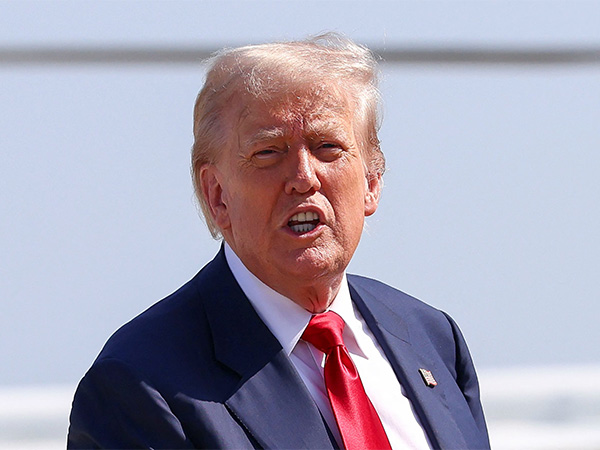
New York/Washington: US President Donald Trump has announced a 50% tariff on oil imports from India, citing the country’s rising purchases of Russian crude. He warned of additional secondary sanctions, stating that India is now “very close” to China in terms of the volume of oil it buys from Russia.
Speaking at the Oval Office on Wednesday, Trump said, “As you know, we’ve imposed a 50% tariff on oil from India. They’re the second largest buyer, and they’re very close to China in terms of Russian oil purchases.”
Earlier in the day, Trump signed an executive order titled “Addressing Threats to the US by the Government of the Russian Federation,” imposing an additional 25% tariff on Indian oil imports, adding to the 25% announced last week. With this, the total US tariff on Indian oil imports now stands at 50% — one of the highest duties imposed by Washington on any country. The latest tariff will take effect in 21 days, by August 27.
At a White House event also attended by Apple CEO Tim Cook, Vice President J.D. Vance, Treasury Secretary Scott Besant, and Commerce Secretary Howard Lutnick, Apple announced a $600 billion investment in the US over the next four years. During the event, Trump fielded several questions about the new tariffs on India.
Asked whether the additional tariffs would be lifted if a peace deal between Russia and Ukraine is reached, Trump replied, “We’ll determine that later. Right now, India is paying a 50% tariff.”
When reporters pointed out that other countries such as China also buy Russian oil, Trump responded, “That’s okay.” Pressed on why India was being singled out, he said, “It’s only been eight hours. Let’s see what happens next… You’re going to see a lot more. There will be many secondary sanctions.”
Currently, only India is facing the full 50% tariff. In comparison, China faces a 30% duty and Türkiye 15%. Asked whether similar penalties would be imposed on China, Trump said, “Could happen. Depends on how we do.”
In response to the move, India’s Ministry of External Affairs (MEA) expressed strong disappointment, calling the decision “extremely unfortunate.”
“It is unfortunate that the US has chosen to impose additional tariffs on India for actions other countries are also taking in pursuit of their national interest,” the MEA said. “We have consistently maintained that our imports are based on market dynamics and aimed at ensuring energy security for our 1.4 billion citizens.”
Calling the tariffs “unfair, unjustified, and unreasonable,” the MEA said India will take “all necessary steps” to safeguard its national interests.
In the executive order, Trump said it was “necessary and appropriate” to impose an additional ad valorem duty on Indian imports because of their links to Russian oil. He stated:
“I find that the Government of India is currently directly or indirectly importing oil from the Russian Federation. Therefore, consistent with applicable law, imports from India will be subject to an additional ad valorem duty of 25%.”
Trump also announced a steep 100% tariff on imported semiconductors and chips. However, he clarified that companies manufacturing in the United States would be exempt: “If you’re building in the US, there is no charge. If you’ve made a commitment or are in the process of building here, there’s no tariff.”
India currently imports about 88% of its crude oil needs, primarily for refining into petrol and diesel. Until 2021, Russian oil accounted for just 0.2% of India’s crude imports. However, following Western sanctions on Moscow after its invasion of Ukraine, discounted Russian oil surged in popularity with Indian refiners. Russia is now India’s top crude supplier.
In July alone, India imported approximately 5 million barrels per day (bpd) of oil, with 1.6 million bpd coming from Russia.
Following the new tariff regime, India, along with Brazil, now faces the highest import duties at 50%. Other countries face significantly lower rates — Myanmar (40%), Thailand and Cambodia (36%), Bangladesh (35%), Indonesia (32%), China and Sri Lanka (30%), Malaysia (25%), and the Philippines and Vietnam (20%).
The announcement comes ahead of the sixth round of negotiations for a proposed bilateral trade agreement (BTA), with a US delegation scheduled to visit India starting August 25.