






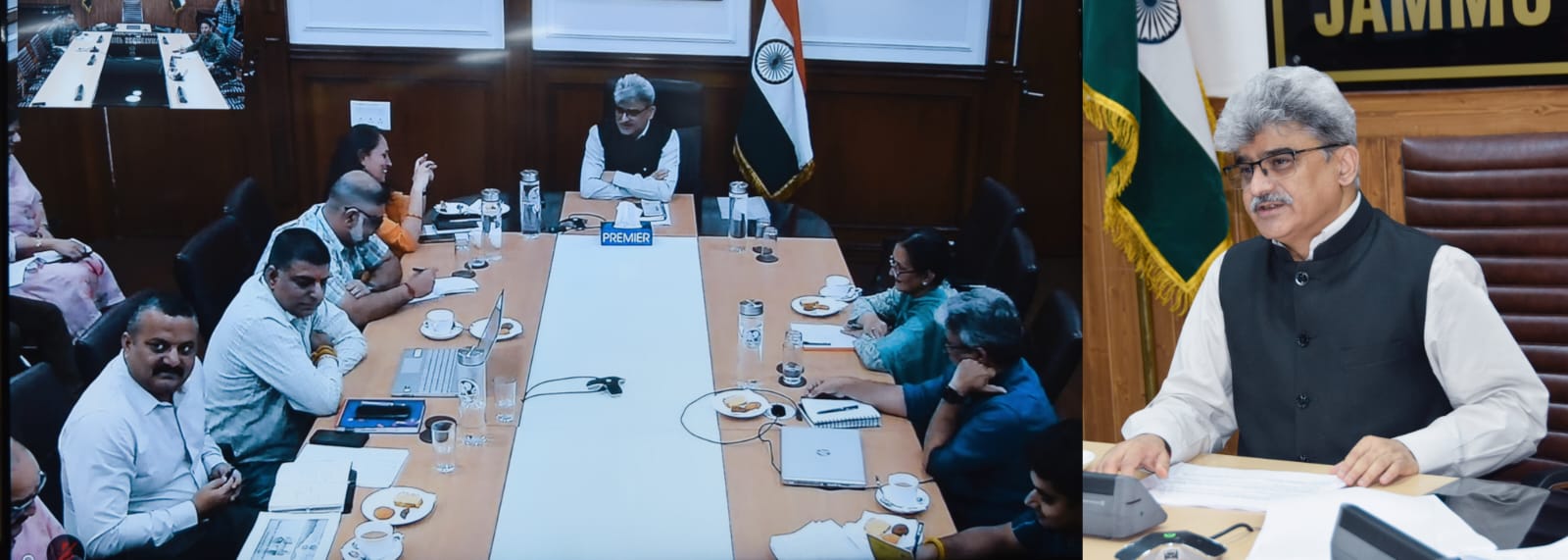
SRINAGAR: Chief Secretary Atal Dulloo today chaired a high-level meeting to review the implementation of compliance reduction and deregulation reforms as recommended by the National Task Force, headed by the Cabinet Secretary, Government of India. The initiative is aimed at promoting Ease of Doing Business (EoDB) across the country.
The meeting was attended by senior officials including the Commissioner Secretaries of Housing & Urban Development, Forest, Industries & Commerce, and Rural Development Departments, along with the Secretary of Law and Director of Industries & Commerce, Jammu, among others.
During the session, the Chief Secretary reviewed the progress of key reforms and directed all departments to ensure time-bound and complete compliance with the Task Force’s agenda. He emphasized the urgency of the exercise, stating that delays or laxity would not be tolerated. Department heads were instructed to regularly monitor implementation and promptly upload evidence of compliance in all priority areas. He stressed that these reforms are crucial to enhancing the overall ease of doing business.
Calling for a mission-mode approach to regulatory reforms, the Chief Secretary tasked the Industries & Commerce Department with facilitating smooth implementation across departments and completing all necessary documentation and reporting without delay.
Commissioner Secretary, Industries & Commerce, Vikramjit Singh, informed the meeting that 434 reform points across departments have already been implemented. However, some points were returned by the Task Force for further refinement. He assured that as the nodal department, Industries & Commerce is actively addressing the gaps and will ensure timely compliance in coordination with concerned departments.
Director, Industries & Commerce, Jammu, Arun Kumar Manhas, highlighted several reform areas requiring immediate attention. These include the adoption of flexible zoning regulations in master plans to support mixed land use, digitization and simplification of the Change of Land Use (CLU) process, and rationalization of minimum road width norms for industrial units in rural areas.
Other reform points discussed included amendments to building regulations to minimize land loss in industrial and commercial plots, removal of restrictions on women working in hazardous sectors, revisions to working hour limits under factory laws, easing restrictions on business hours for commercial establishments, and provision of fire NOCs through empanelled third-party agencies.
These reforms, he noted, aim to create a robust, business-friendly industrial ecosystem in the Union Territory.
It is worth mentioning that the Business Reforms Action Plan (BRAP), launched by the Department for Promotion of Industry and Internal Trade (DPIIT), is a flagship initiative of the Government of India designed to streamline regulations and enhance ease of doing business nationwide.