






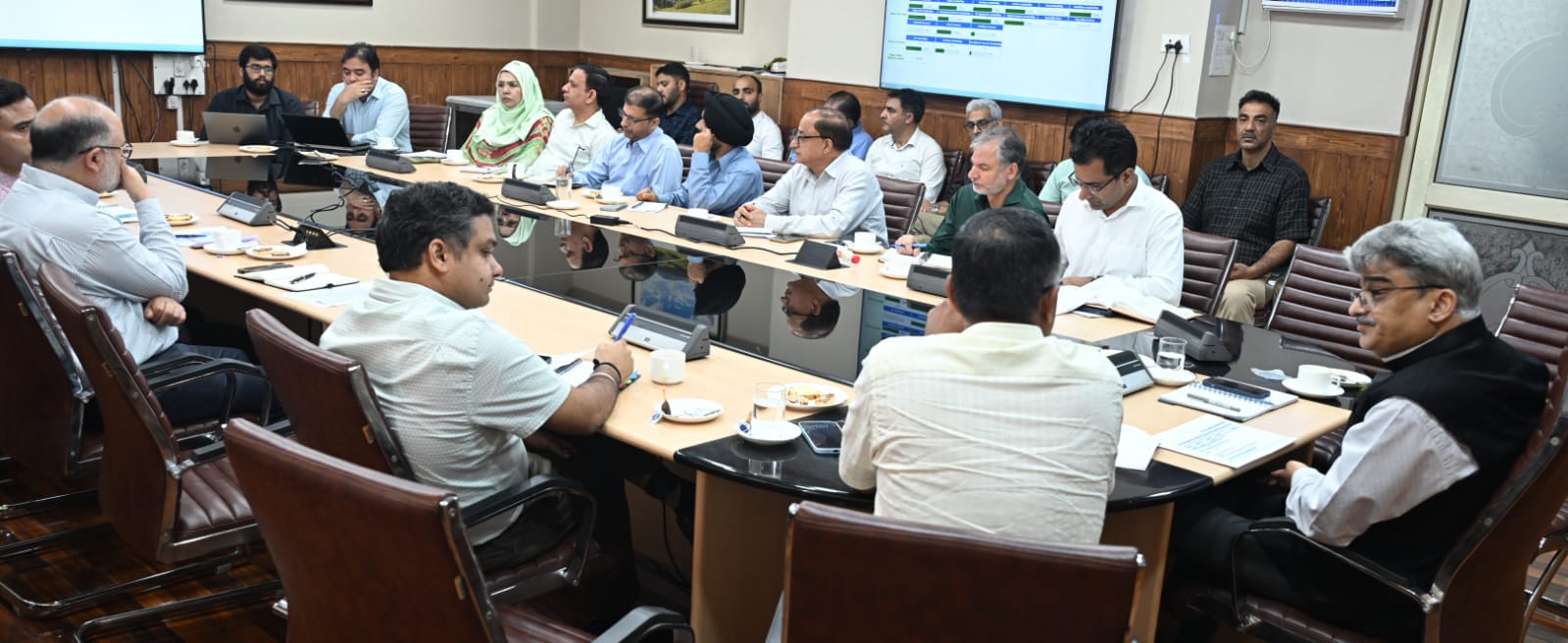
SRINAGAR: Chief Secretary Atal Dulloo today directed the Agriculture Production Department (APD) to transform Kisan Khidmat Ghars (KKGs) into dynamic, multipurpose village centres, positioning them as “instruments of change” for the farming community across Jammu & Kashmir.
Chairing a high-level meeting to review KKG operations across districts, the Chief Secretary lauded the initiative as a “phenomenal programme” conceptualised by national experts, with the potential to boost agricultural growth, enhance farmer awareness, and promote best practices. He emphasised that every farm family should have at least one member registered with a KKG, highlighting the centres’ vital role in providing timely advisories, personalised guidance, and knowledge of modern, scientific farming techniques.
To increase their utility, the Chief Secretary instructed that KKGs also serve as Common Service Centres (CSCs) for online government services, custom hiring centres for farm machinery, and Direct Selling Agents (DSAs) for banks to facilitate farmers’ financial access.
He further tasked the MD of the Holistic Agriculture Development Programme (HADP) with preparing a comprehensive list of agriculture-related business ventures that Krishi Udhyamis (KUs) could operate at these centres. Deputy Commissioners were asked to circulate success stories from existing centres to inspire wider replication.
Reviewing the status of KKGs under Phases I and II, the Chief Secretary sought updates from each Deputy Commissioner on operational readiness, including IT infrastructure—desktops, printers, broadband—and licenses for the sale of seeds, fertilisers, and pesticides by eligible KUs.
Principal Secretary APD, Shailendra Kumar, directed Deputy Commissioners to set strict timelines for operationalising new centres, ensure provisioning of IT equipment, adopt Point of Sale (PoS) machines for fertiliser sales, and implement proactive public outreach to boost farmer registrations and service uptake.
MD HADP, Sandeep Kumar, reported that under Phase I, 500 KKGs are now operational across J&K, supported by a dedicated mobile application. Nearly 5 lakh farmers have registered on the KKG platform, with 1.25 lakh app downloads—96% on Android devices. Rajouri leads in registrations, with over 84,000 farmers on board.
The KKG app now features advanced tools such as a decision-support system for cherry and apple growers, grievance ticket management, push notifications for advisories, and a gamification-based registration system, where 23% of users have achieved Level 2 registration.
Under Phase II, 297 new centres in Jammu Division and 287 in Kashmir Division are ready for launch, significantly expanding the programme’s outreach and impact.
The Chief Secretary emphasised that the KKG initiative’s success reflects the joint efforts of the administration and farming community. By combining technology-driven services, knowledge dissemination, and business opportunities, KKGs are set to play a transformative role in strengthening agriculture and improving farmer livelihoods across Jammu & Kashmir.