







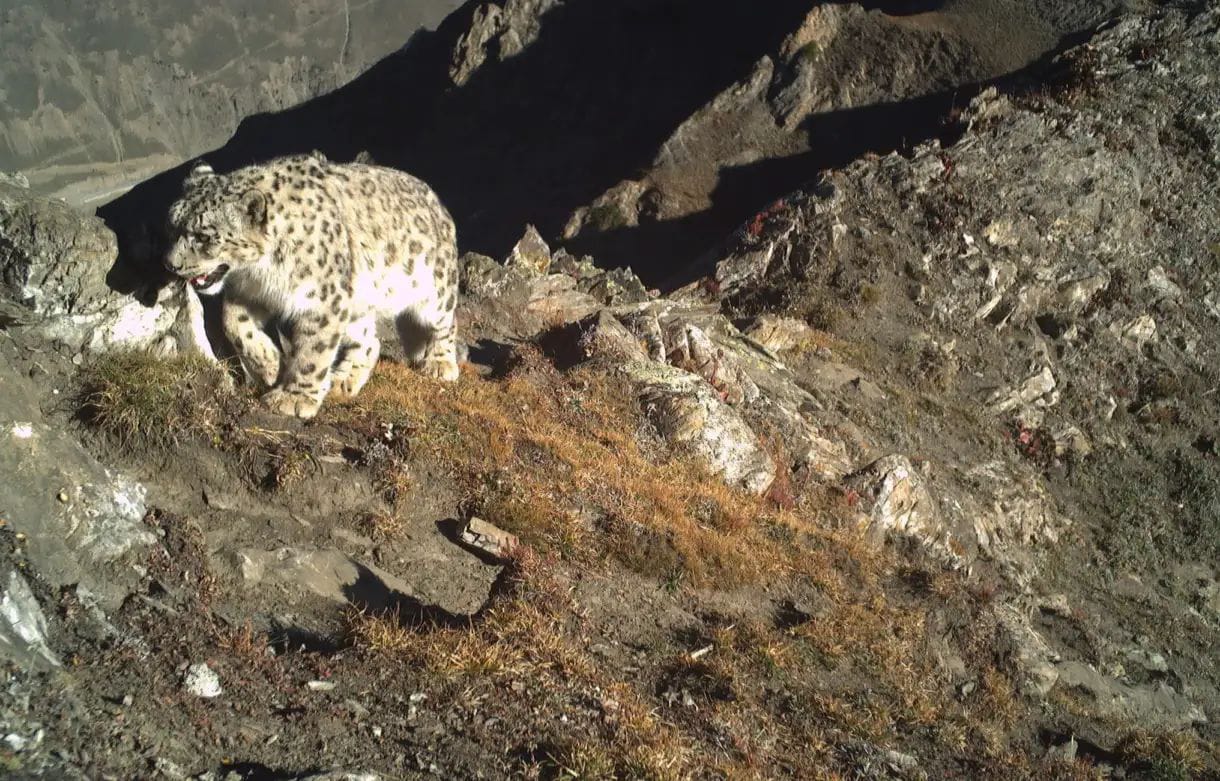
New Delhi: The snow leopard, one of the world’s most elusive big cats, is not only surviving but thriving in Jammu and Kashmir, according to a new survey. Long known only through anecdotal sightings and occasional camera-trap footage, the species’ presence in the region had remained largely unverified—posing a challenge for researchers trying to estimate the population of these highly vulnerable apex predators.
A landmark study by the Nature Conservation Foundation (NCF) and the Jammu and Kashmir Wildlife Protection Department has now confirmed the year-round presence and breeding activity of snow leopards in the Union Territory, marking a significant breakthrough for high-altitude biodiversity conservation in India.
Conducted from 2022 to 2025 across the Kishtwar Himalayas under the nationwide Snow Leopard Population Assessment in India (SPAI) protocol, and supported by the Royal Enfield Social Mission, the study combined extensive camera trapping with rigorous field surveys.
“We started the project in 2022 and confirmed snow leopards’ presence in J&K,” said Shahid Hameed, Wildlife Research and Project Coordinator at NCF and co-author of the study. “Previously, surveys in the Western Himalayas were limited to Ladakh, Himachal Pradesh, and Uttarakhand. Our study is the first to verify a resident population in J&K.”
The study captured the first photographic evidence of snow leopards (Panthera uncia) in Kishtwar High Altitude National Park, documenting at least four individual cats. Winter camera trapping—despite snow depths of 10–12 feet—confirmed that snow leopards in the region are residents, not seasonal migrants.
Over 3,000 camera trap nights across Kishtwar, Paddar, and Zojila identified at least 12 adult snow leopards, with an estimated population of up to 20. The presence of a mother with cubs confirms breeding activity.
“This reaffirms J&K as a key snow leopard stronghold,” Hameed said. “The Kishtwar Himalayas should be treated as an interconnected conservation landscape rather than isolated valleys.”
The survey also recorded 16 other mammal species, including Himalayan brown bear, Himalayan wolf, common leopard, Kashmir musk deer, Asiatic ibex, and red fox.
Vigyat Singh, Director-Operations at the Eicher Group Foundation, noted that snow leopards are an indicator species: “Conserving their habitat reflects the overall health and resilience of high-altitude ecosystems.”
The team also conducted landscape-level threat assessments by interviewing over 300 households, identifying livestock depredation and crop damage as major challenges. Six outreach workshops engaged over 1,200 participants in biodiversity education, human-wildlife conflict mitigation, and conservation practices.
The findings emphasize the need for adaptive, landscape-level conservation strategies aligned with Project Snow Leopard and the Kunming-Montreal Global Biodiversity Framework, which prioritize local community involvement.
Hameed stressed that climate-driven events such as landslides and cloudbursts, which have recently impacted J&K, underline the vulnerability of these high-altitude ecosystems. “While such events may not directly impact snow leopards, they foreshadow negative consequences for both the species and its habitat.”
The authors aim to continue monitoring snow leopards in the Kishtwar Himalayas to understand their spatial and seasonal movements, interactions with humans and other species, and responses to climate-driven changes, ensuring evidence-based conservation interventions for the future.