






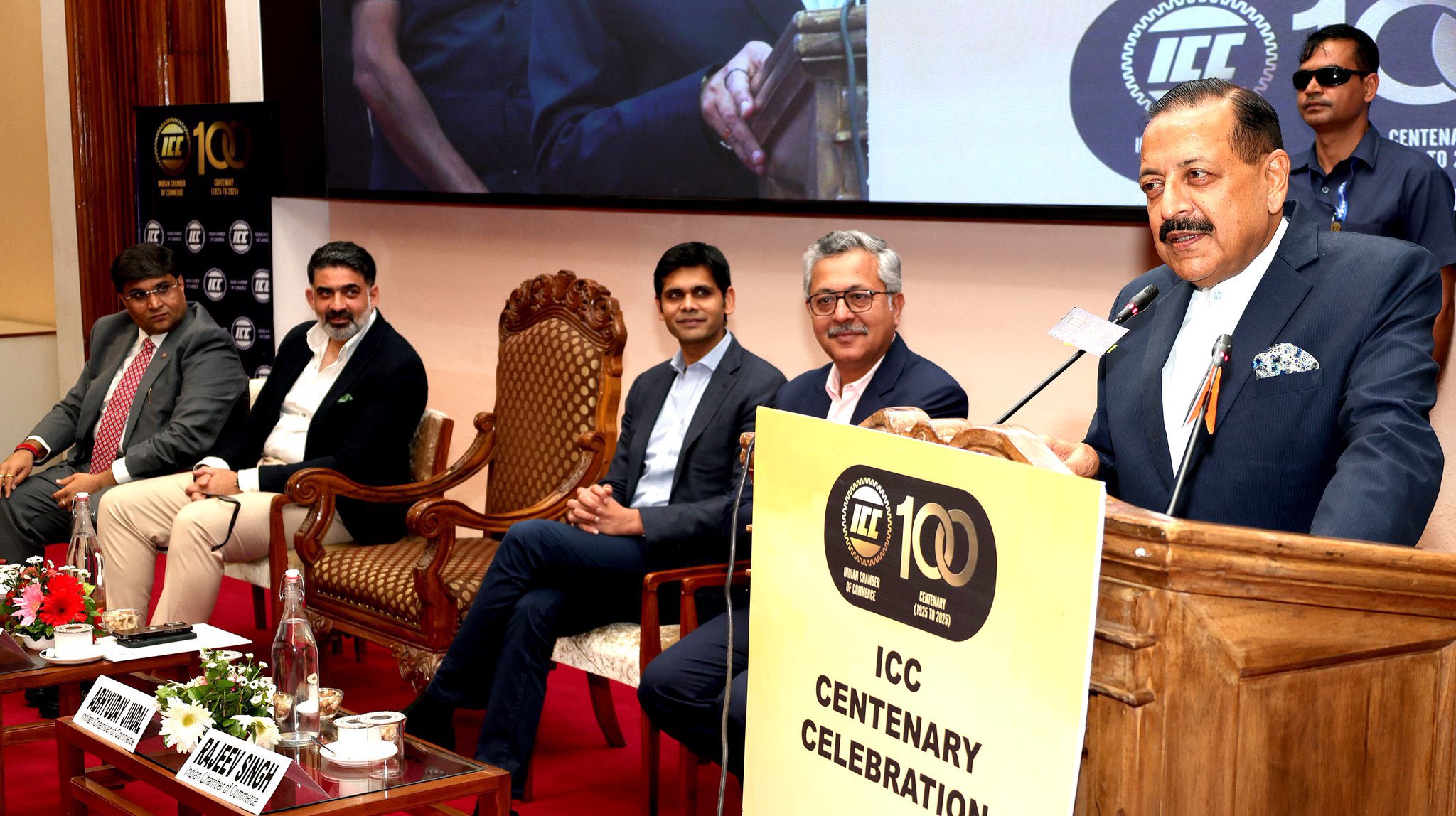
Srinagar: Union Minister Jitendra Singh on Monday highlighted Jammu and Kashmir’s potential to become a major driver of India’s economic growth, urging the Indian Chamber of Commerce (ICC) to actively facilitate private sector engagement in the Union Territory.
“The Union Territory has immense economic potential, but partnership between government and industry is crucial,” Singh said at the ICC Centenary Retreat in Srinagar. He noted that the Modi government has removed longstanding barriers between public and private sectors, opening even strategic areas such as nuclear energy to private investment. “Now it is time for industry to take the lead,” he added.
Singh cited the “purple revolution” of lavender cultivation and advances in apple farming by local self-help groups—including women-led initiatives—as examples of successful public-private collaboration that have increased yields and improved produce longevity. He urged the ICC to help entrepreneurs connect with government agencies and private players at a larger scale.
Highlighting the country’s start-up boom, Singh noted that nearly 1.7 lakh ventures are now registered, with over 60% originating from tier-2 and tier-3 towns. “Cities like Srinagar are well-positioned to ride this wave. With the right ecosystem, J-K can emerge as a hub of innovation and entrepreneurship,” he said.
The minister also emphasized that sectors once reserved for the public domain, such as space and biotechnology, are now open to private investment, and frameworks for collaboration are already in place. He predicted that India’s next economic revolution will be biotechnology-driven and stressed that J-K must actively participate in this transformation.
Calling the ICC retreat both timely and symbolic, Singh said it demonstrated the Union Territory’s readiness to integrate into India’s mainstream economic growth. “This is the best time for industry to engage with J-K. What is needed is a clear plan and timeline to make it happen,” he said.
At a separate event at the Islamic University of Science and Technology (IUST), Awantipora, Singh inaugurated the DST Inclusive Technology Business Incubator (i-TBI) and iFactory Lab, announcing a Rs 5-crore support package from the Department of Science and Technology. He said the initiative aims to build a vibrant start-up ecosystem in J-K, beginning with 15 start-ups and growing to 30 within three years, ensuring the region’s youth do not miss India’s innovation revolution.
Singh also unveiled a Technology Innovation Hub (TI Hub) and announced a 12-month faculty development program, emphasizing the importance of embracing new-age knowledge to remain globally competitive. The iFactory Lab, set up under the Ministry of Heavy Industries’ C4i4 initiative, will expose students to Industry 4.0 technologies such as AI, robotics, and data analytics. Singh praised IUST’s Centre for Innovation and Entrepreneurship Development (CIED-IUST Foundation) as a model for integrating incubation, technology development, and start-up support in higher education.
Noting that over 65% of J-K’s population is under 35, Singh stressed that innovation and entrepreneurship are critical to addressing high youth unemployment. He urged universities, parents, and industry partners to nurture young entrepreneurs instead of pushing them toward conventional career paths. “Kashmiri youth often excel when they move out. Our collective responsibility is to create the same opportunities here so they can thrive at home,” he said.
Singh concluded that J-K’s young innovators could become “torchbearers of India’s growth story,” emphasizing that the initiatives at IUST are designed not only to transform the region locally but also to enable J-K’s active contribution to India’s leadership in science, technology, and innovation.