






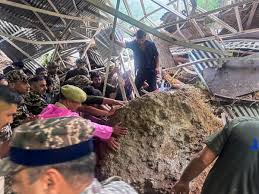
Jammu/Srinagar: Torrential rains battered Jammu and Kashmir on Tuesday, unleashing flash floods and landslides that killed at least 13 people, including nine pilgrims struck by a massive landslide on the Vaishno Devi route.
Rivers across the region swelled above danger levels, washing away infrastructure and cutting off vast areas. In Jammu, flash floods and landslides forced the suspension of the pilgrimage to the hilltop shrine of Mata Vaishno Devi, while the Kashmir Valley witnessed bridges collapsing, mobile towers crumbling, and power poles toppling like twigs. Telecom services broke down across much of the Union Territory, leaving millions without communication.
Disaster on the Vaishno Devi Route
The tragedy unfolded around 3 pm near Adhkwari, halfway along the 12-km trek from Katra to the shrine, when a mountainside gave way. Nine people were killed and 21 injured, with several feared trapped under debris near the Inderprastha Bhojnalaya. The old route to the shrine was closed around 1.30 pm, hours after the Himkoti trek had been suspended due to the rains.
Survivors described a hail of stones, boulders, and uprooted trees crashing down the slopes. Kiran, a pilgrim from Mohali, recounted from her hospital bed, “I saw stones falling and rushed to safety, but I was injured. Out of five in our group, three are hurt.”
Relatives crowded hospitals and the base camp in Katra for news of loved ones. Some of the injured were shifted to Narayana Hospital, 15 km from Jammu. The Army rushed three relief columns to Katra and surrounding areas to assist in rescue and evacuation.
Wider Impact Across Jammu Region
Elsewhere, four deaths were reported in Doda district — three people drowned after slipping into a river, and one died when a house collapsed. Hundreds were evacuated from low-lying areas as floods swept through Kathua, Reasi, Rajouri, Ramban, and Poonch. The full extent of damage will only emerge after ground assessments, officials said.
Chief Minister Omar Abdullah chaired an emergency meeting, terming the situation “serious.” He directed district officials to stay on high alert, release emergency restoration funds, and ensure food, water, and medicines reached affected families. Relief efforts would prioritize vulnerable groups, he said.
Rivers Overflow, Districts Flooded
The Ravi river at Modhopur barrage in Kathua crossed the one-lakh cusec mark, flooding vast stretches. Major rivers — Chenab, Tawi, Ujh, and Taranah — also breached danger levels, forcing repeated appeals from police for residents to move to safer areas.
According to the Meteorological Department, Kathua received 155.6 mm of rainfall in 24 hours, followed by Bhaderwah in Doda (99.8 mm), Jammu (81.5 mm), and Katra (68.8 mm). With the forecast warning of more heavy rain, cloudbursts, flash floods, and landslides until August 27, authorities advised people to avoid rivers and vulnerable slopes.
Services Paralyzed
The downpour disrupted life across the Union Territory. Communication lines collapsed after fibre cables were damaged, delaying rescue coordination and causing widespread panic. Schools in the Jammu division were ordered shut until August 27, while board exams for Classes 10 and 11 were postponed. A recruitment drive for security force constables in Jammu was also suspended.
The disaster came just 12 days after flash floods triggered by a cloudburst killed 65 people in Kishtwar district’s Chisoti village near the Machail Mata temple. For residents of the region, despair has returned once again.