






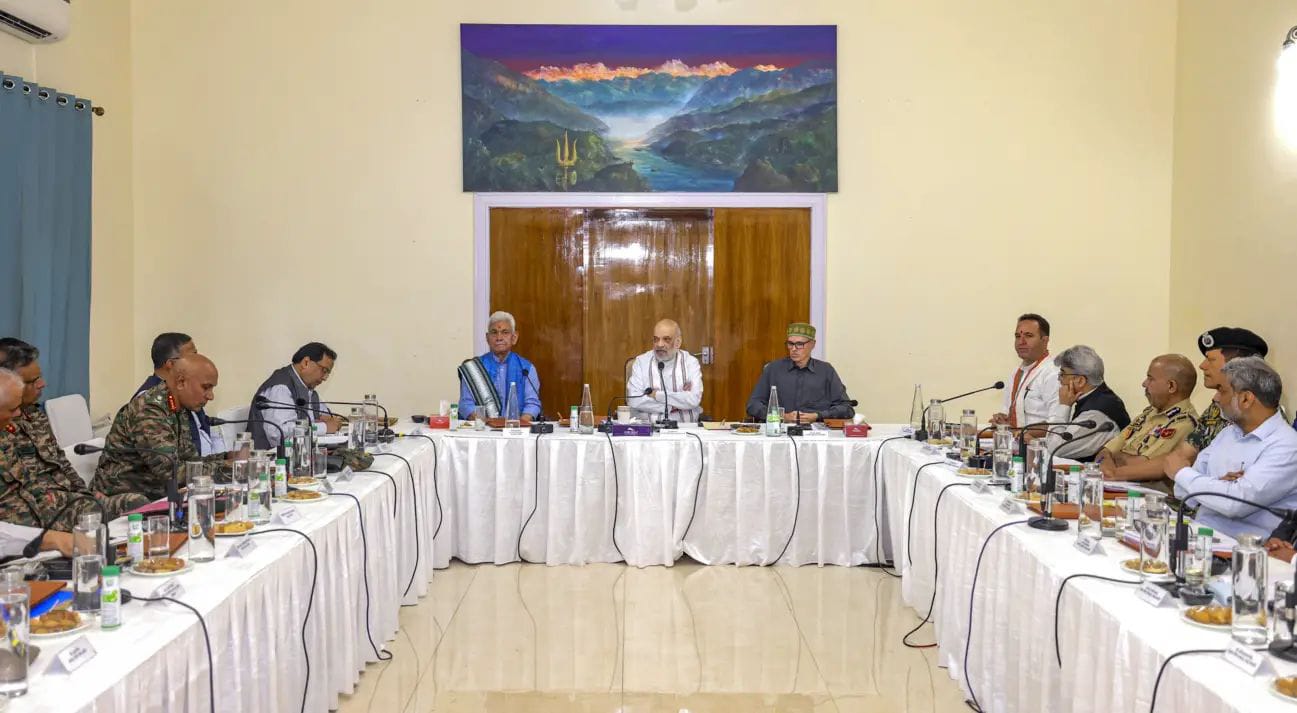
Jammu: Union Home Minister Amit Shah on Monday stressed the importance of using data analytics and artificial intelligence to study the causes of cloudbursts and conducting a critical review of the early warning system for glacial lake outburst floods (GLOFs), while expressing condolences for the loss of lives in the recent disasters.
Chairing a high-level meeting at Raj Bhavan after touring the worst-affected areas since August 14, Shah assured citizens that the Centre stands firmly with them, providing immediate relief and financial assistance.
He praised the swift and efficient rescue operations carried out by the Jammu and Kashmir government and other agencies. “More than 80% of electricity has been restored, and people are receiving safe drinking water,” he said.
The meeting was attended by Lieutenant Governor Manoj Sinha, Chief Minister Omar Abdullah, and senior officials from both the Central and Union Territory governments.
Shah expressed grief over the loss of lives and noted, “From the very first day, Prime Minister Narendra Modi has been in touch with the L-G and the Chief Minister. The Government of India has mobilized all resources for rescue efforts.”
He highlighted the need for a detailed review of all Early Warning Apps (EWAs), their accuracy, and reach to the grassroots level, emphasizing that critical analysis is key to moving toward zero casualties. Shah also called for a joint study by the Meteorological Department and National Disaster Management Authority to understand cloudburst tendencies, moisture patterns, and improve GLOF early warning systems.
Shah instructed the Ministry of Home Affairs to leverage data analytics and AI to enhance disaster preparedness. He also directed the Food Corporation of India to arrange additional rations, with offline delivery options to be decided after assessing connectivity over the next ten days.
Advanced survey teams from the Ministry of Home Affairs will assess damage, and further assistance will follow. Shah announced that a meeting with relevant Central and Union Territory departments, including the Union Home Secretary, would be held within a day or two to prioritize damage assessment.
He urged health and water departments to focus proactively on essential services, with support from medical units of the Army, Central Armed Police Forces, and Air Force.
Highlighting financial preparedness, Shah noted that Rs 209 crore has been allocated for Jammu and Kashmir under the State Disaster Response Fund (SDRF) to address natural calamities. Timely warnings from the Centre and Union Territory Disaster Management Authority minimized casualties, and response teams—including the NDRF, Army, UTDRF, CAPFs, and helicopters—were on alert.
Assistance for damaged private homes is being assessed for prompt disbursal. Repair and restoration of multiple damaged roads are underway, with traffic resuming on most routes and relief reaching affected areas.
Shah said over 5,000 people were evacuated as a precautionary measure, with 17 NDRF teams, 23 Army columns, IAF helicopters, UTDRF, J-K Police, and CAPFs personnel engaged in the operations.
He reaffirmed that under Prime Minister Modi’s leadership, the Union Government remains committed to supporting Jammu and Kashmir with relief, financial aid, and technical assistance to facilitate recovery and reconstruction.