







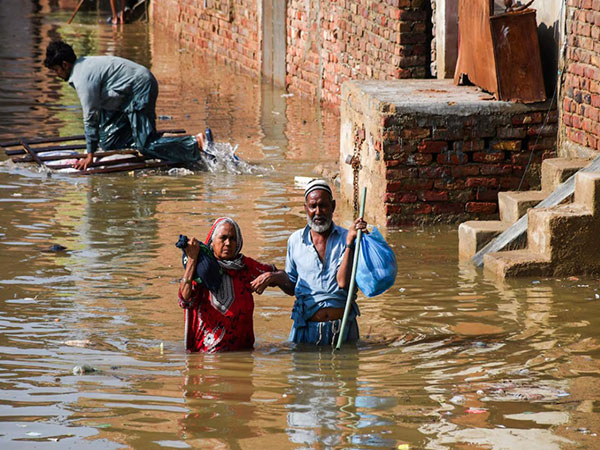
Punjab Braces for “Super Flood” as Ravi and Chenab Rivers Threaten Multan, Muzaffargarh
Multan [Pakistan]: Provincial authorities in Punjab are on high alert as the swollen Ravi and Chenab rivers converge near Khanewal, posing a severe flood risk to Multan and Muzaffargarh, Dawn reported. Officials warned of a “dual threat” despite several controlled breaches conducted over the past week.
Water levels at Muhammadwala and Sher Shah reached 412 feet, just five feet below critical levels. Authorities termed the next 12 hours as crucial, noting increasing pressure at breaching points following the rivers’ convergence.
To protect urban areas along the eastern rivers, the Punjab government has been carrying out controlled breaches to relieve pressure on barrages and main embankments, safeguarding densely populated cities. Decisions on breaches at Head Muhammadwala, Sher Shah Flood Bund, and Rangpur are expected within hours, with 17 points identified to protect Multan and Muzaffargarh.
The situation is exacerbated by a massive surge of roughly 550,000 cusecs passing the Marala and Khanki Headworks, with 530,000 cusecs recorded at Qadirabad Headworks. Officials projected the surge would reach Trimmu Headworks on Thursday and Multan by Friday.
“The next 12 hours are extremely critical. We are facing a dual threat: the existing high water from the confluence and a new, massive wave heading directly for us. All resources are being mobilised,” a Provincial Disaster Management Authority (PDMA) official said.
Railway traffic to Karachi and vice versa was suspended from Faisalabad after a Chenab River bridge in Abdul Hakim became submerged.
At a Wednesday evening press conference, PDMA Director General Irfan Ali Kathia warned the crisis would intensify as all three major Indian dams were expected to reach maximum capacity within 72 hours, worsening an already catastrophic situation in Punjab’s river system. “The next 72 hours are critical,” he said.
While the Chenab River’s levels remain stable, previously affected districts may face renewed flooding. The Sutlej River has experienced flood-like conditions for two months, and the Ravi River’s levels are rising at the Jassar monitoring point.
“The Thein Dam is already full and will continue releasing water into the Ravi for the next two to three weeks. While the situation may not be as severe as before, water levels will increase,” DG Kathia explained. Alarmingly, the Ravi’s waters are flowing backwards instead of merging with the Chenab, delaying any decrease in levels. “Until Ahmadpur Sial’s levels drop, Sidhnai will not see relief,” he added.
Punjab CM Maryam Nawaz personally inspected the critical Head Muhammadwala site. DG Kathia said only four to five feet of capacity remain before reaching critical levels, and at Sher Shah Bridge in Multan, there is a mere two-foot margin. Controlled breaches in Multan have been planned to prevent uncontrolled overflow.
Over 3,900 villages and more than 3.7 million people have been affected across Punjab. The death toll has risen to 46, while over 1.4 million residents and one million animals have been relocated to safer areas. Relief efforts include 409 flood camps providing essential facilities to around 25,000 displaced persons. In Khanewal and Toba Tek Singh, 136 and 75 villages have been affected, with numbers expected to rise due to renewed surges.
CM Maryam Nawaz visited flood relief camps in Multan, instructing district administrations to assess damage, ensure clean drinking water, and carry out fumigation and germicidal sprays in camps and tent cities.
As of 11 pm Wednesday, Marala Headworks on the Chenab recorded a declining flow of 444,754 cusecs, while Khanki and Qadirabad held steady at 558,683 and 557,440 cusecs, respectively. Other key points—including Chiniot Bridge, Head Muhammadwala, Rivaz Bridge, and Trimmu Headworks—showed varying rising or stable trends.
For the Ravi River, upstream at Jassar, flows were receding at 82,140 cusecs, while downstream points like Ravi Syphon and Shahdara recorded rising levels. The Sutlej River system remained stable across all monitoring stations, including GS Wala, Sulemanki, Islam, Panjnad Headworks, and Malsi Syphon.