






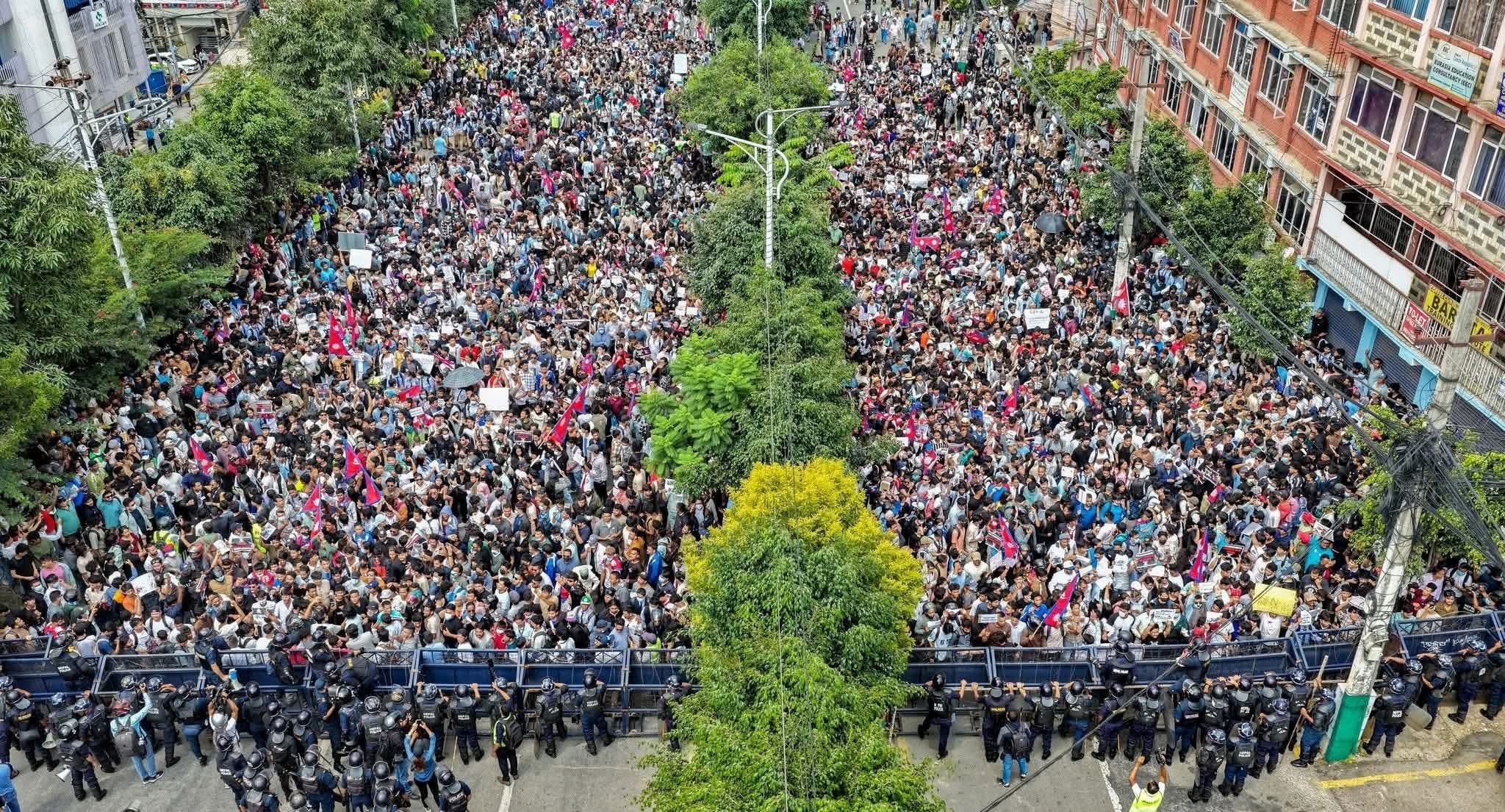
KATHMANDU: At least 14 people were killed and dozens injured on Monday as violent protests erupted in Nepal’s capital and other areas over the government’s decision to ban social media platforms. The unrest prompted authorities to deploy the army in Kathmandu to restore order.
Thousands of youths, including school students, rallied under the banner of Gen Z in front of the Parliament, chanting anti-government slogans and demanding an immediate revocation of the ban.
While Nepalese media reported 14 deaths, official figures on casualties have not yet been confirmed. Eyewitnesses said the demonstration turned violent when some protesters entered the Parliament complex, prompting police to use batons, tear gas, and rubber bullets to disperse the crowd.
According to the Himalayan Times, hospital reports indicate that the deceased include six at Trauma Centre, three at Civil Hospital, three at Everest Hospital, one at Kathmandu Medical College, and one at Tribhuvan University Teaching Hospital. Similarly, news portal Khabarhub and Kantipur newspaper also reported 14 fatalities, citing hospital and health ministry sources.
A Nepal Police spokesperson said 42 people, including two security personnel, were injured and are receiving treatment at Civil Hospital in Kathmandu. The Himalayan Times added that the actual number of injured remains unclear due to the large influx of patients, with hospitals like Civil Hospital and Trauma Centre referring some cases to other facilities.
The army has been deployed to help control the situation. In response to the violence, the local administration imposed a curfew in several parts of Kathmandu. The unrest has also spread to other cities. The Kathmandu District Administration issued a prohibitory order from 12:30 pm to 10:00 pm around the Parliament building, banning public movement, gatherings, or demonstrations, which was later extended to areas near Rastrapati Bhawan, the Vice-President’s residence, and the Prime Minister’s Office.
The government banned 26 social media platforms—including Facebook, WhatsApp, X, Instagram, and YouTube—on Thursday, citing their failure to register with the Ministry of Communication and Information Technology within the given deadline. While authorities maintain that the ban is meant to regulate social media, critics argue it threatens free speech and could lead to censorship.
Prime Minister K P Sharma Oli said on Sunday that his government would “always oppose anomalies and arrogance” and would not tolerate acts undermining the nation. He clarified that the government is not against social media but objects to companies operating in Nepal without complying with the law, calling critics “puppets who only oppose for the sake of opposing.”
The protests have also drawn support from journalists, who gathered at Maitighar Mandala on Sunday to voice opposition to the social media ban. Meanwhile, the Computer Association of Nepal (CAN) warned that shutting down major platforms simultaneously could disrupt education, business, communication, and daily life, potentially leaving Nepal digitally behind. CAN president Sunaina Ghimire urged discussions with stakeholders to find practical solutions.
Adding to the unrest, a youth-led campaign called “Nepo Kid” has gained traction on social media. The trend criticizes the children of politicians and influential figures for enjoying privileges funded by corruption, further fueling protests among Nepalese youths.