






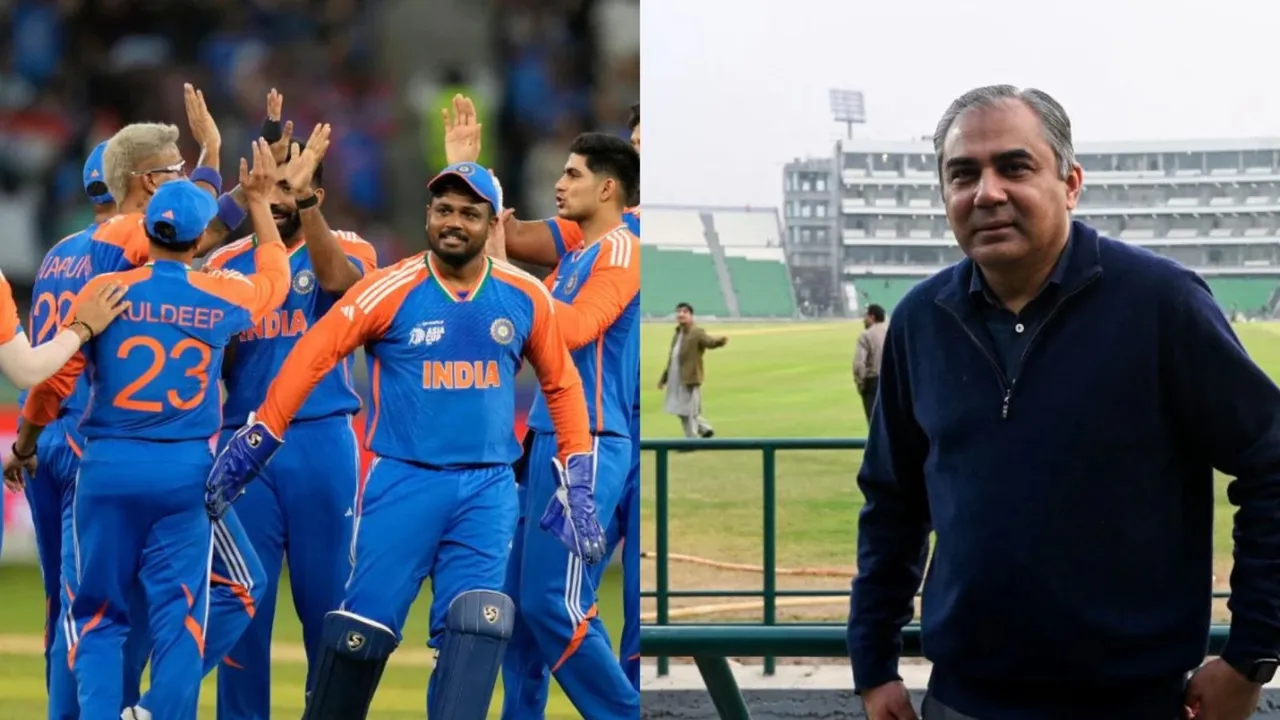
Dubai: The refusal of Indian players to shake hands with their Pakistani counterparts after an Asia Cup clash here has escalated into a major controversy, with the Pakistan Cricket Board (PCB) demanding the removal of match referee Andy Pycroft, whom they hold responsible for the incident that has reignited tensions between the two cricketing rivals.
India captain Suryakumar Yadav defended his team’s decision following their seven-wicket win on Sunday, stating that it was intended as a mark of solidarity with the families of the Pahalgam terror attack, in which 26 people were killed by Pakistan-backed terrorists.
The move came after India faced criticism for playing against Pakistan, prompting an angry response from the PCB. The board lodged a complaint with the Asian Cricket Council (ACC) and has now sought the intervention of the International Cricket Council (ICC).
Notably, PCB chief Mohsin Naqvi also serves as ACC head, while ICC president is India’s Jay Shah. However, the Asia Cup is organized by the ACC, not the ICC.
“The PCB has lodged a complaint with the ICC regarding violations by the match referee of the ICC Code of Conduct and MCC Laws related to the Spirit of Cricket. The PCB has demanded the immediate removal of the match referee from the Asia Cup,” Naqvi said on X.
The PCB earlier claimed that Pycroft “asked Pakistan captain Salman Ali Agha, at the toss, not to shake hands with his Indian counterpart.” Pakistan team manager Naved Cheema also filed a complaint with the ACC, alleging that it was Pycroft’s instruction that prevented the customary exchange of team sheets between the captains.
The BCCI has not responded to the PCB’s statements, but sources indicate that if India reaches the Asia Cup final on September 28, the players are unlikely to share the presentation ceremony with Naqvi, who is expected to hand over the winner’s trophy as ACC head.
Both teams avoided interactions during pre-match warm-ups, and at the toss, the captains handed over their team sheets directly to Pycroft.
A PCB statement said, “Team manager Naved Cheema lodged a strong protest against Indian players’ behaviour of not shaking hands. It was deemed unsporting and against the spirit of the game. As a protest, we did not send our captain to the post-match ceremony.”
India’s stance marks a clear departure from the usually apolitical approach that players maintain when facing Pakistan.
“Together, we came here, we took a call, and I feel we came here just to play the game. I think we gave the proper reply,” Suryakumar said when asked about his team’s decision.
When a Pakistani journalist asked whether the refusal to shake hands was politically motivated, the Indian captain said: “I feel some things in life are above the sportsman’s spirit. We stand with the victims of the Pahalgam terror attack and dedicate this victory to our Armed Forces.”
Head coach Gautam Gambhir echoed the sentiment, explaining to the tournament broadcaster that the decision was carefully discussed by the BCCI and team management. Social media and opposition parties in India had criticized the match, arguing that playing Pakistan ignored the sentiments of families affected by the April terror attack.
Gambhir and senior players agreed that handshakes would be avoided at all times during the match. The policy, which was approved by senior BCCI officials, may continue if the teams meet again in the Super Four stage or the final.
“Look, if you read the rulebook, there is no requirement to shake hands with the opposition. It is a goodwill gesture, a convention, not a law, followed globally in sports,” a senior BCCI official told reporters here. “If there is no law, the Indian cricket team is not obliged to shake hands with a team with which there is a history of strained relations.”
Historically, avoiding handshakes for political reasons is not unprecedented in sports. In the 2023 Wimbledon women’s singles, Ukrainian Elina Svitolina refused to shake hands with Belarus’s Victoria Azarenka after her victory, citing the Russian and Belarusian attacks on her nation. Wimbledon did not penalize the players.
While geopolitical tensions sometimes affect sporting events, countries often maintain standard courtesies; for instance, the USA and Iran teams shook hands during World Cup matches despite longstanding political conflict.
Although India faced criticism for playing Pakistan, the government’s policy allows Indo-Pak cricket matches at multi-nation events, partly due to India’s ambitions in hosting major global sporting events, including the 2028 Olympics in Los Angeles, the 2030 Commonwealth Games, and the 2036 Olympics in Ahmedabad. Refusing to play Pakistan at such events could negatively impact India’s international image.
As a result, India will continue to face Pakistan in tournaments like the Asia Cup and World Cup, but any camaraderie on the field is unlikely to return in the foreseeable future.