






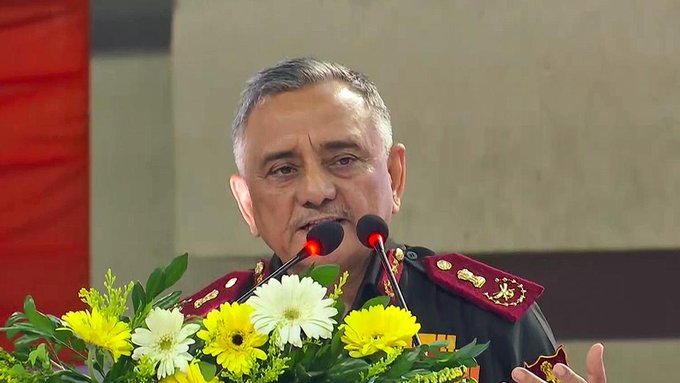
PUNE: Chief of Defence Staff General Anil Chauhan has stated that the use of the Air Force could have significantly slowed the Chinese offensive during the 1962 Sino-Indian War. While such action might have been considered “escalatory” at the time, he noted that this perception has changed, as evidenced by Operation Sindoor.
Reflecting on the war 63 years ago, General Chauhan observed that India’s forward policy should not have been applied uniformly to Ladakh and NEFA (present-day Arunachal Pradesh). He argued that the two regions had distinct historical disputes, different terrains, and varied security contexts, making a single policy approach flawed.
“The security situation has evolved over the years, and the nature of warfare itself has transformed,” the CDS said.
General Chauhan made these remarks in a recorded video message shown on Wednesday during the release of the revised autobiography of the late Lieutenant General S P P Thorat, Reveille to Retreat, in Pune. Lt Gen Thorat was the General Officer Commanding-in-Chief of Eastern Command before the Sino-Indian War.
Calling the autobiography more than a soldier’s memoir, General Chauhan said it provides valuable insights into leadership, strategy, and India’s military history.
Addressing questions about the forward policy and the non-use of the Indian Air Force (IAF) in 1962, he said, “It is difficult to comment on the adequacy of the forward policy in retrospect. Geography and geopolitics have changed significantly since then.”
He added, “In Ladakh, China had already occupied much of Indian territory, while India’s claim in NEFA was stronger. Applying identical policies to both regions was, in my view, flawed.”
General Chauhan noted that Lt Gen Thorat had considered using the IAF, but the government at the time did not allow it. “Air power could have slowed, if not completely stopped, the Chinese offensive. It would have given the Army crucial time to prepare. Back then, such action was deemed escalatory; today, Operation Sindoor demonstrates that this is no longer the case.”
Operation Sindoor, conducted in May this year, involved India deploying air power to dismantle terror hubs in Pakistan and PoK following the Pahalgam massacre in April.
“Reveille to Retreat is not merely an autobiography; it is a reflection on leadership, strategy, and service. It examines decisions of power, critiques them honestly, and draws lessons that remain relevant today,” General Chauhan said.
He recalled Lt Gen Thorat’s distinguished career, spanning pre- and post-independence India, which included service in conflict zones like Waziristan, Peshawar, and Burma’s Arakan (now Rakhine). His leadership earned him the Distinguished Service Order, and he later fought in the battles of Kohima and Imphal.
Lt Gen Thorat also commanded the Custodian Force in Korea after the Armistice and was awarded the Ashoka Chakra Class II (later renamed the Kirti Chakra) and the Padma Bhushan. “Korea remains divided along the 38th parallel, one of the world’s most volatile fault lines, illustrating the enduring relevance of the conflicts he helped manage,” the CDS said.