






Union Minister Dr. Jitendra Singh on Friday praised the Sree Chitra Tirunal Institute for Medical Sciences and Technology (SCTIMST), Thiruvananthapuram, for developing affordable, high-quality medical devices, and urged wider production and greater public awareness of these innovations.
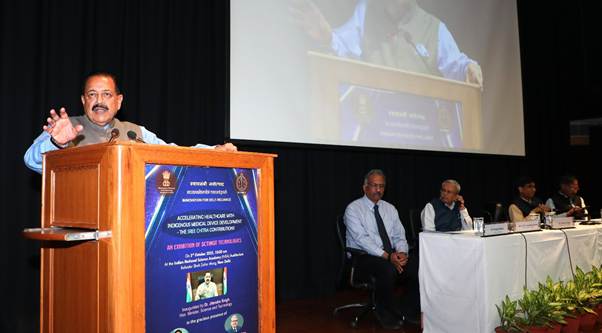
Inaugurating the exhibition “Innovation for Self-Reliance – Accelerating Healthcare with Indigenous Medical Device Development – The Sree Chitra Contributions”, Dr. Singh said India has the potential to become a global hub for cost-effective healthcare. He suggested showcasing SCTIMST’s devices in central locations like Delhi to ensure wider recognition and outreach.
Highlighting the institute’s contributions to the vision of Atmanirbhar Bharat, Vishwabandhu Bharat, and Viksit Bharat 2047, he noted achievements such as providing heart valves to over two lakh patients, advanced shunts to around 2,000 patients, and innovations like the Hemostasis Patch for trauma and battlefield care. However, he emphasized the need to scale up production and ensure their availability in leading hospitals.
Dr. Singh described SCTIMST as a unique Indian model that integrates “Four Ts” — Teaching, Training, Treatment, and Trade — combining healthcare delivery with education and economic value creation.
He underlined the rapid growth of India’s medical technology sector, currently valued at USD 12 billion and projected to reach USD 50 billion by 2030, with nearly 20 percent annual growth. With WHO recognition and collaborations with ICMR, DBT, CSIR, DRDO and INSA, SCTIMST is well-placed to play a key role in this expansion.
Stressing affordability as the core principle, Dr. Singh said industry partnerships and expanded production could strengthen India’s position as a leader in global healthcare and medical tourism by 2047.
“By building on its achievements, Sree Chitra can meet national health priorities while also serving global demand, reinforcing India’s role as a trusted contributor to world healthcare,” he added.
The event was attended by Prof. Ashutosh Sharma, Dr. Abhay Karandikar, Prof. Kris Gopalakrishnan, Dr. Sanjay Behari, along with senior faculty, scientists, and industry partners.