






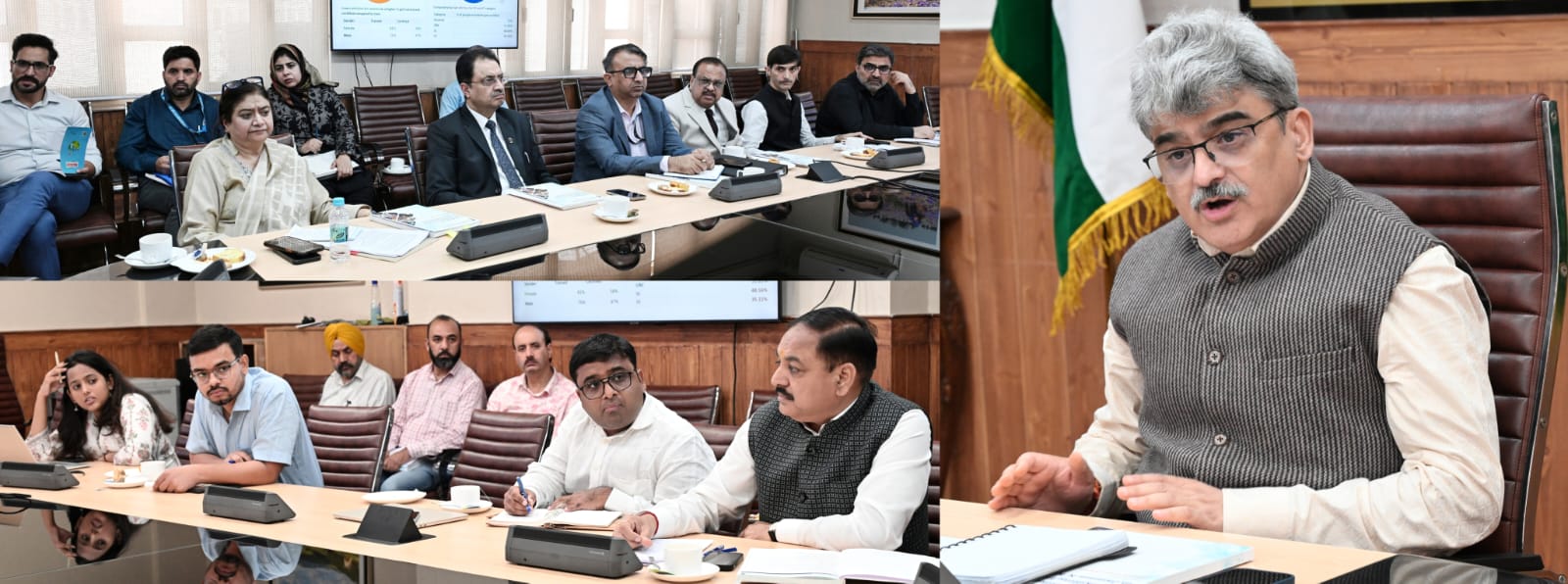
SRINAGAR: Chief Secretary Atal Dulloo today chaired a high-level meeting to review the Comprehensive Action Plan (CAP) for skill development across Jammu and Kashmir.
The meeting focused on devising a holistic strategy to build a future-ready workforce, enhance employability, develop skilled professionals, and create sustainable livelihood opportunities across the region.
The session was attended by Additional Chief Secretary, Higher Education, Shantmanu; Principal Secretary Finance, Santosh D Vaidya; Secretary School Education, Ram Niwas Sharma; Secretary, Skill Development Department (SDD), Kumar Rajeev Ranjan; Managing Director, Skill Development Mission; Secretary BOTE; Director, Skill Development; representatives from various universities, and other senior officials.
During the meeting, the Chief Secretary emphasized that the success of the plan hinges on its effective implementation at the grassroots level. He highlighted the importance of seamless coordination between the Education and Skill Development departments, calling it crucial for achieving the objectives of this ambitious initiative.
Outlining the guiding framework, Atal Dulloo stressed that successful skilling relies on four key pillars: the availability of high-quality master trainers, robust curriculum development, adequate infrastructure, and the establishment of viable skill models. He further emphasized the need for private sector participation in building a future-ready workforce.
“Skill training cannot be managed by a few institutions or individuals alone. Without master trainers, even the best frameworks or regulatory models cannot succeed,” he asserted. He also underlined that skilling is not solely the responsibility of the Skill Development Department. “Universities, schools, and polytechnics must all contribute in line with their strengths,” he added.
The Chief Secretary cautioned against setting unrealistic targets, stressing that quality must take precedence over quantity. “Even if we are able to skill five lakh individuals with quality training, that would be a remarkable achievement,” he noted.
The meeting also discussed strengthening polytechnics, regulating private skill institutions, and promoting multiple skilling models tailored to local needs. He suggested that banks could provide ‘Skill Loans’ to support institutes and entrepreneurs, thereby enhancing the overall skilling ecosystem. Departments were urged to further refine the plan by clearly defining course identification processes, qualification criteria for master trainers, curriculum design, and infrastructure requirements such as labs and training facilities.
Highlighting the importance of skill development in ensuring sustainable livelihoods, the Chief Secretary called for convergence of efforts among schools, colleges, universities, ITIs, and polytechnics, with active participation from private institutions. Reviewing departmental progress under various schemes, he encouraged officials to move beyond conventional training by integrating toolkits and credit linkages to empower beneficiaries and enhance livelihood opportunities.
Reiterating the goal of creating a skilled and empowered workforce in J&K, Atal Dulloo emphasized that the core objective is to establish an ecosystem where government and private institutions work together to achieve sustainable and inclusive skill development.