






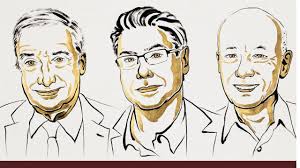
STOCKHOLM: Joel Mokyr, Philippe Aghion, and Peter Howitt have been awarded the Nobel Memorial Prize in Economic Sciences for their groundbreaking research on “innovation-driven economic growth.”
Mokyr is affiliated with Northwestern University, Aghion with the Collège de France and the London School of Economics, and Howitt with Brown University.
The Nobel committee noted that Mokyr’s work shows how continuous innovation requires not only practical success but also a deep scientific understanding of why technologies work. Aghion and Howitt were recognized for their analysis of the mechanisms that sustain long-term economic growth. In their influential 1992 paper, they introduced a mathematical model explaining “creative destruction” — the process by which new, superior products replace outdated ones, driving progress but also disrupting existing industries.
“The laureates’ research demonstrates that economic growth is not guaranteed,” said Per Krusell, chair of the Nobel Committee for Economic Sciences. “To prevent stagnation, societies must preserve and encourage the forces of creative destruction.”
Last year’s prize went to Daron Acemoglu, Simon Johnson, and James A. Robinson for their work on why some nations prosper while others remain poor, emphasizing that open and inclusive institutions foster greater economic success.
Formally known as the Bank of Sweden Prize in Economic Sciences in Memory of Alfred Nobel, the award was established in 1968 by Sweden’s central bank to honor Nobel, the 19th-century inventor of dynamite and founder of the original Nobel Prizes.
Since its inception, the economics prize has been awarded 56 times to 96 laureates — only three of whom have been women. While technically not one of the original Nobel Prizes, it is presented alongside the others each year on December 10, the anniversary of Alfred Nobel’s death.
This year’s prize follows last week’s announcements in medicine, physics, chemistry, literature, and peace.