






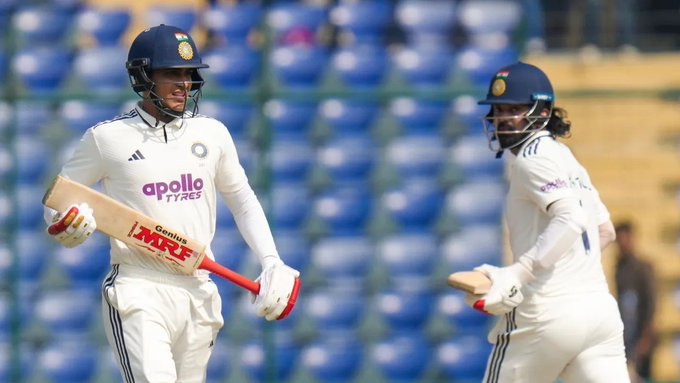
New Delhi: India wrapped up the formalities in just about an hour on Tuesday, defeating the West Indies by seven wickets in the second and final Test to complete a 2–0 series sweep. The dominant hosts were rarely tested, save for some resistance towards the end of the series.
The win not only reaffirmed India’s supremacy at home but also marked Shubman Gill’s first series victory as Test captain. Chasing a modest target of 121, India needed only 58 runs on the final morning. KL Rahul (58* off 108 balls) guided the side home alongside Dhruv Jurel (6*), sealing victory in 35.2 overs. Rahul struck six fours and two sixes, and shared a 79-run stand with Sai Sudharsan (39) for the second wicket.
Although the Test extended into the fifth day — thanks to gritty centuries from John Campbell (115) and Shai Hope (103) and a stubborn final-wicket stand — the Feroz Shah Kotla pitch remained low and slow, offering minimal turn to the spinners.
Over the two Tests, Indian bowlers captured all 40 opposition wickets, with pacers excelling on unresponsive surfaces and spinners showing discipline when conditions were placid. Among batters, India’s top order produced five centuries and a 90-plus score across the series.
However, when viewed in context, the performance gains appear limited. None of the West Indies’ top-order batters average above 35 in Tests, and apart from Jayden Seales, most of their bowlers have little first-class experience. Seales, notably, went wicketless in this match, while Jomel Warrican managed just one scalp after taking three in the first innings.
Despite a late fight, Roston Chase became only the second West Indies captain after Kraigg Brathwaite to lose his first five Tests in charge.
India’s next challenge will be against South Africa, where conditions are expected to be far more demanding. Early signs from the ongoing Pakistan–South Africa Test in Lahore suggest that the Gaddafi Stadium pitch is offering sharp turn and variable bounce — with 15 of the 16 wickets so far falling to spinners.
This raises an important question: should India continue to play on flat tracks when facing a much stronger South African batting unit featuring Aiden Markram, Ryan Rickelton, Wiaan Mulder, Dewald Brevis, Tristan Stubbs, and Tony de Zorzi? If Indian spinners struggled to dismiss a modest Caribbean side on a benign surface, they could face greater challenges against the Proteas.
For head coach Gautam Gambhir, the wounds from last year’s home whitewash against New Zealand are still fresh. Yet, the decision to prepare rank turners remains risky — while it helps India’s spinners, it can also expose the inexperience of a relatively young batting line-up.
Except for KL Rahul and Ravindra Jadeja, most of India’s current batters are still establishing themselves. However, both Yashasvi Jaiswal and Shubman Gill have enough maturity now to handle testing conditions. It’s worth recalling that Virat Kohli’s Test average dipped during India’s turner-heavy phase, even as those same pitches transformed Ravichandran Ashwin and Jadeja into match-winners.
On flatter surfaces, finger spinners like Jadeja and Washington Sundar tend to be less effective, whereas Kuldeep Yadav’s wrist spin remains a more potent weapon.
The venues for the upcoming two-Test series against South Africa will thus play a key role in assessing India’s strength at home — especially with no red-ball cricket scheduled for the next eight months before the Sri Lanka tour.
At Eden Gardens, the pitch has rarely been a rank turner, typically offering seam movement early and late in the day while remaining a good batting surface otherwise. Meanwhile, Barsapara Stadium in Guwahati, which is set to host its first-ever Test, presents an element of mystery — both in terms of its pitch behaviour and match dynamics.