






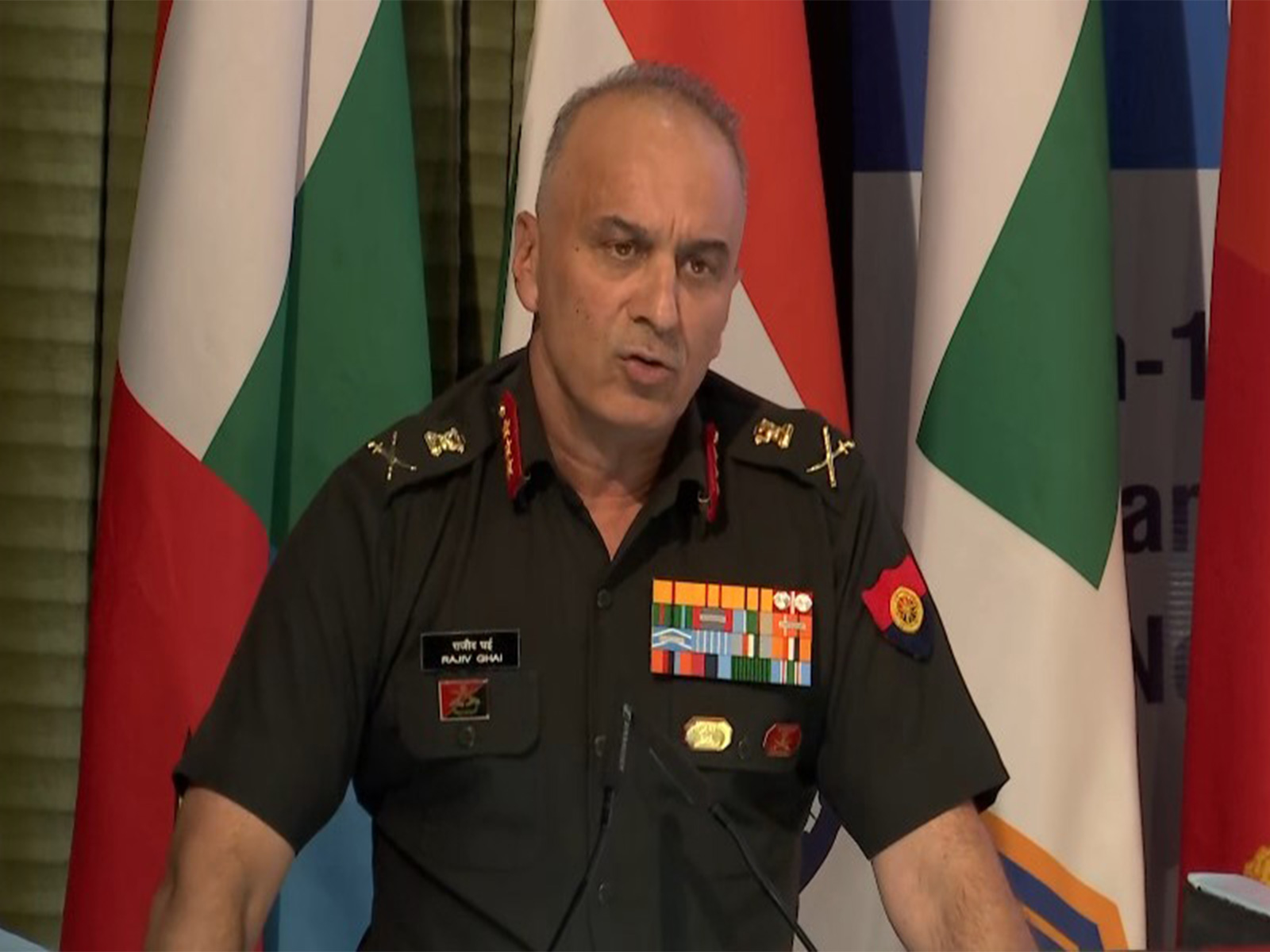
New Delhi:India successfully achieved its political and military objectives during Operation Sindoor, which was launched to punish Pakistan for sponsoring cross-border terrorism, said Director General of Military Operations (DGMO) Lieutenant General Rajiv Ghai. He noted that the operation reflected a “maturing of India’s doctrine beyond the binaries of peace and war.”
Speaking at the United Nations Troop Contributing Countries (UNTCC) Chiefs’ Conclave, Lt Gen Ghai described Operation Sindoor—conducted in response to the Pahalgam terror attack—as an exercise combining “military precision and diplomatic agility, informational superiority and economic leverage.”
He said India, a long-standing contributor to UN peacekeeping missions, had recently navigated “the complexities of modern conflict” through the operation.
“This was not a distant engagement. It was a direct response to evolving threats, complex operational environments, and our imperative to counter the scourge of terrorism,” he stated.
Recalling India’s earlier responses to terror attacks, including the 2016 surgical strikes and the 2019 Balakot aerial strikes, Lt Gen Ghai said this time, “it was the intensity and magnitude of the events that compelled us to respond with the kind of action you are all well familiar with.”
Tracing the roots of terrorism in Jammu and Kashmir, he said, “It was in the late 1980s that this problem began. Since then, there have been over 28,000 terror incidents. More than 100,000 members of minority communities—over 60,000 families—were forced to migrate, while 15,000 innocent civilians and over 3,000 security personnel have lost their lives. And it is very clear where this comes from.”
The DGMO underlined that Operation Sindoor was part of a long-evolving trajectory of India’s calibrated responses. “It is not as if Operation Sindoor happened overnight,” he said, recalling India’s mobilisation after the 2001 Parliament attack, the 2016 Uri attack, and the 2019 Balakot strikes. “But this time, the intensity and magnitude of the events compelled a more decisive response.”
Lt Gen Ghai also referred to Pakistan’s reaction after Operation Sindoor, saying India’s decisive military action exposed “the blatant nexus between the Pakistani Army and terrorist groups.”
“The fact that the Pakistan Army and its chief were under duress at the time is known to everybody. There was a need to revive not only his image but also that of the Army. The only way known to them was to do what they did—cowardly as it may have been,” he said.
He cited instances of open collusion, including a UN-proscribed terrorist leading prayers for those killed, attended by senior Pakistani military and government officials—among them Lt Gen Fayyaz Hussain Shah (Corps Commander IV Corps), Maj Gen Rao Imran Sartaj (GOC 11 Infantry Division), Brig Mohd Furqan Shabbir (Commander 15 Heavy Mechanised Brigade), Punjab IGP Usman Anwar, and provincial legislator Malik Sohaib Ahmed Bherth.
Lt Gen Ghai also mentioned India’s decision to suspend the Indus Waters Treaty following the Pahalgam attack as part of a comprehensive response.
“Eighty-eight hours is what it took for the enemy to ask for cessation of hostilities,” he said. “We achieved our political and military aims. We hit nine targets across the breadth of Pakistan. This was a fusion of military precision and diplomatic agility, informational superiority, and economic leverage.”
He emphasised that India’s actions were “targeted, controlled, non-escalatory,” and were “openly acknowledged to maintain credibility.”
“We also implemented significant conventional measures to apply pressure, including telling forward deployments that extended our punitive reach to unprecedented levels,” he added.
In May this year, India carried out precision strikes on terror infrastructure in Pakistan and Pakistan-occupied Jammu and Kashmir (PoJK) following the Pahalgam terror attack. The Indian Armed Forces repelled Pakistan’s subsequent aggression and targeted its airbases, leading to Pakistan’s DGMO calling his Indian counterpart to request cessation of hostilities.