






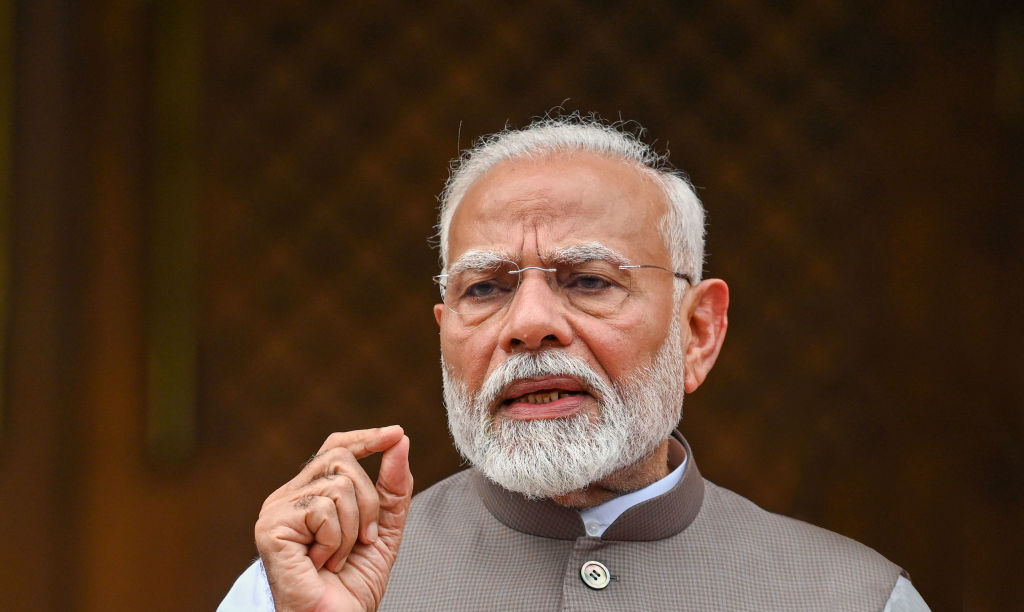
KURNOOL (ANDHRA PRADESH): Prime Minister Narendra Modi on Thursday said the 21st century belongs to 140 crore Indians and reaffirmed his vision of transforming India into a “Viksit Bharat” (Developed India) by 2047.
Praising the success of the Make in India initiative, the Prime Minister said the country witnessed the strength of indigenous capabilities during Operation Sindoor — a military offensive against cross-border terror launchpads in Pakistan following the April 22 Pahalgam terror attack.
“By 2047, the centenary of India’s Independence, we will achieve the goal of a Viksit Bharat,” Modi declared, addressing a public gathering after inaugurating and laying foundation stones for development projects worth over ₹13,000 crore. “I can confidently say that the 21st century belongs to India,” he added.
Modi praised the leadership of Andhra Pradesh Chief Minister N. Chandrababu Naidu and Deputy Chief Minister Pawan Kalyan, stating that the Centre and the state government were working in full coordination.
Highlighting the recent Google AI Hub investment, the Prime Minister announced that a new international sub-sea gateway will be developed in Visakhapatnam, linking several undersea cable systems and enhancing global digital connectivity.
“In the past 16 months, Andhra Pradesh’s development journey has accelerated, with unprecedented progress under the double-engine government,” he said, adding that the state was emerging as both a cultural centre and a hub of science and innovation.
The Prime Minister noted that the new projects inaugurated or launched would improve infrastructure, connectivity, and industrial growth while enhancing the quality of life for the people.
Taking a dig at the Congress, Modi said that 11 years ago, during its rule, the average per capita power consumption in India was below 1,000 units, and the country suffered frequent blackouts with villages lacking basic electricity poles.
Earlier, the Prime Minister inaugurated and laid the foundation for multiple projects worth ₹13,430 crore across key sectors including industry, power transmission, roads, railways, defence manufacturing, and petroleum and natural gas.
He laid the foundation for the Transmission System Strengthening Project at Kurnool-III Pooling Station, worth over ₹2,880 crore. He also launched industrial projects at Orvakal in Kurnool and Kopparthy in Kadapa, involving investments of over ₹4,920 crore.
Developed jointly by the National Industrial Corridor Development and Implementation Trust (NICDIT) and the Andhra Pradesh Industrial Infrastructure Corporation (APIIC), these hubs feature modern, multi-sectoral infrastructure with a “plug-and-play” setup and a walk-to-work concept. They are expected to attract ₹21,000 crore in investments and generate around one lakh jobs, significantly boosting the Rayalaseema region’s economy.
Modi also laid the foundation for the six-lane greenfield highway from Sabbavaram to Sheelanagar, costing over ₹960 crore, and inaugurated several road projects including the four-laning of the Pileru–Kalur section, the widening of the Kadapa–Nellore border–CS Puram stretch, and a new four-lane rail overbridge between Gudivada and Nujella on NH-165.
In the railway sector, the Prime Minister laid foundation stones and inaugurated projects worth over ₹1,200 crore, including the Kothavalasa–Vizianagaram Fourth Railway Line, a rail flyover between Pendurthi and Simhachalam North, and the doubling of the Kottavalasa–Boddavara and Shimiliguda–Gorapur sections.
In the energy sector, Modi inaugurated GAIL’s Srikakulam–Angul Natural Gas Pipeline, built at a cost of around ₹1,730 crore, covering 124 km in Andhra Pradesh and 298 km in Odisha. He also launched Indian Oil’s ₹200 crore LPG bottling plant at Chittoor and Bharat Electronics Limited’s ₹360 crore Advanced Night Vision Products Factory at Nimmaluru in Krishna district.
Before the event, the Prime Minister offered prayers at the Sri Bhramaramba Mallikarjuna Swamy temple in Srisailam, where he performed Rudrabhishekam with Panchamritam — a sacred mixture of milk, curd, ghee, honey, and sugar. Chief Minister Naidu and Deputy CM Pawan Kalyan accompanied him during the temple visit.
Later, Modi visited the Sree Shivaji Spoorthi Kendra, a memorial complex featuring models of four iconic forts — Pratapgad, Rajgad, Raigad, and Shivneri — surrounding a statue of Chhatrapati Shivaji in deep meditation. The centre, run by the Sree Shivaji Memorial Committee, was built to commemorate Shivaji’s historic visit to the Srisailam shrine in 1677.