






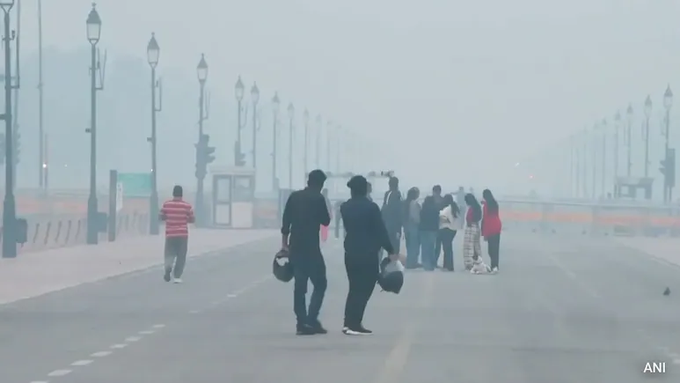
NEW DELHI: Delhi’s air quality worsened sharply on Diwali, with 34 of the 38 monitoring stations recording pollution levels in the ‘red zone’ on Monday, indicating ‘very poor’ to ‘severe’ conditions across the city.
According to official data, the capital’s 24-hour average Air Quality Index (AQI), measured at 4 p.m. daily, stood at 345, up from 326 on Sunday — both falling in the ‘very poor’ category.
Data from the SAMEER app, developed by the Central Pollution Control Board (CPCB), showed that four monitoring stations — Dwarka (417), Ashok Vihar (404), Wazirpur (423), and Anand Vihar (404) — had already entered the ‘severe’ category with AQI levels exceeding 400. Around 30 other stations reported ‘very poor’ air, with AQI readings above 300.
By afternoon, 31 out of 38 stations were in the ‘very poor’ range, while three stations had crossed into the ‘severe’ zone. Officials warned that overall air quality could deteriorate further, slipping deeper into the ‘severe’ category on Tuesday and Wednesday.
The CPCB classifies air quality as follows:
0–50: Good
51–100: Satisfactory
101–200: Moderate
201–300: Poor
301–400: Very Poor
401–500: Severe
According to the Decision Support System (DSS), transport emissions contributed 15.6% to Delhi’s overall pollution on Monday, while industrial and other sources accounted for 23.3%.
In anticipation of worsening conditions, the Commission for Air Quality Management (CAQM) had already enforced Stage II of the Graded Response Action Plan (GRAP) across Delhi-NCR on Sunday, following a review by its sub-committee and forecasts from the India Meteorological Department (IMD) and the Indian Institute of Tropical Meteorology (IITM).
Earlier, on October 15, the Supreme Court permitted the sale and use of green firecrackers in Delhi-NCR during restricted hours — from 6 a.m. to 7 p.m., and again from 8 p.m. to 10 p.m. on Diwali eve and the festival day.