







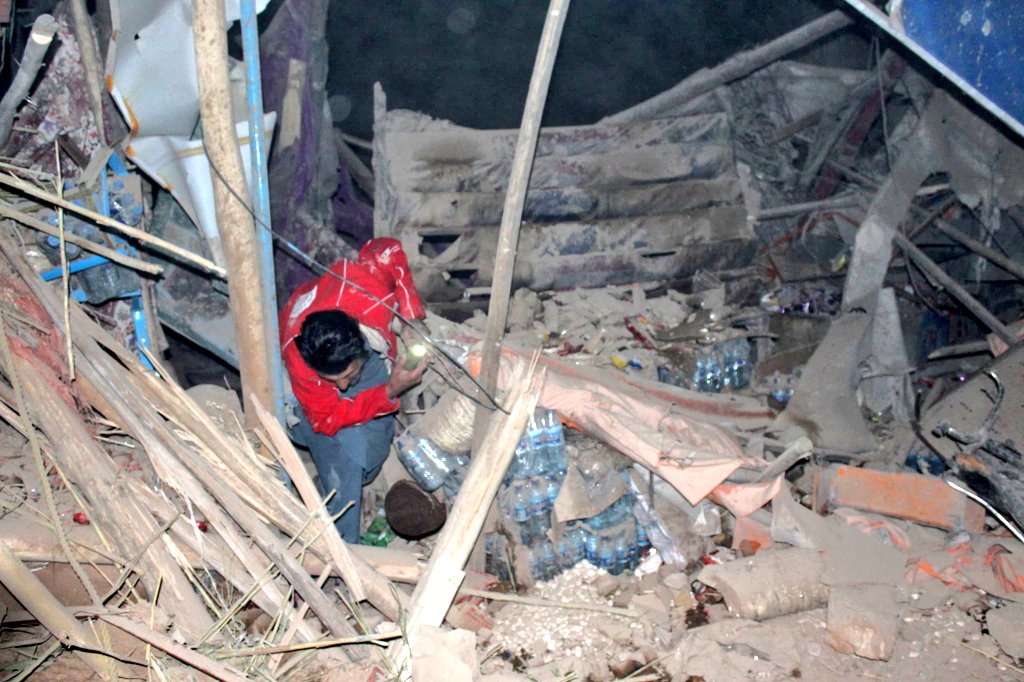
Kabul: A powerful earthquake measuring 6.3 on the Richter scale struck northern Afghanistan early Monday, leaving at least seven people dead and more than 100 injured, according to media reports.
The US Geological Survey (USGS) issued an orange alert through its PAGER system—an automated tool that assesses earthquake impacts—warning that “significant casualties are likely and the disaster is potentially widespread.”
Videos circulating on social media platform X showed rescue teams working to free people trapped under debris, along with scenes of collapsed buildings and widespread destruction.
This comes just weeks after a 4.9-magnitude quake hit southeastern Afghanistan on September 23, as reported by the GFZ German Research Centre for Geosciences. That tremor had a shallow epicentre at a depth of 10 km, located at 34.48°N latitude and 70.71°E longitude.
Since the Taliban’s return to power in 2021, Afghanistan has been hit by several devastating earthquakes. In 2023, a powerful quake in the western Herat region near the Iranian border killed over 1,500 people and destroyed more than 63,000 homes. Another 6.0-magnitude quake struck eastern Afghanistan on August 31 this year, killing more than 2,200 people, making it one of the deadliest in recent history.
Afghanistan sits along the collision zone between the Eurasian and Indian tectonic plates, with additional pressure from the Arabian plate to the south—placing it among the most seismically active regions in the world.
Compounding its vulnerability, the country is struggling with decades of conflict, extreme poverty, severe drought, and the forced repatriation of millions of Afghans from Pakistan and Iran.
According to seismologist Brian Baptie of the British Geological Survey, northeastern Afghanistan has recorded 12 earthquakes above magnitude 7 since 1900. More than 355 quakes exceeding magnitude 5.0 have been documented nationwide since 1990.
The eastern and northeastern provinces—particularly those bordering Uzbekistan, Tajikistan, and Pakistan—remain the most earthquake-prone zones in the country.