






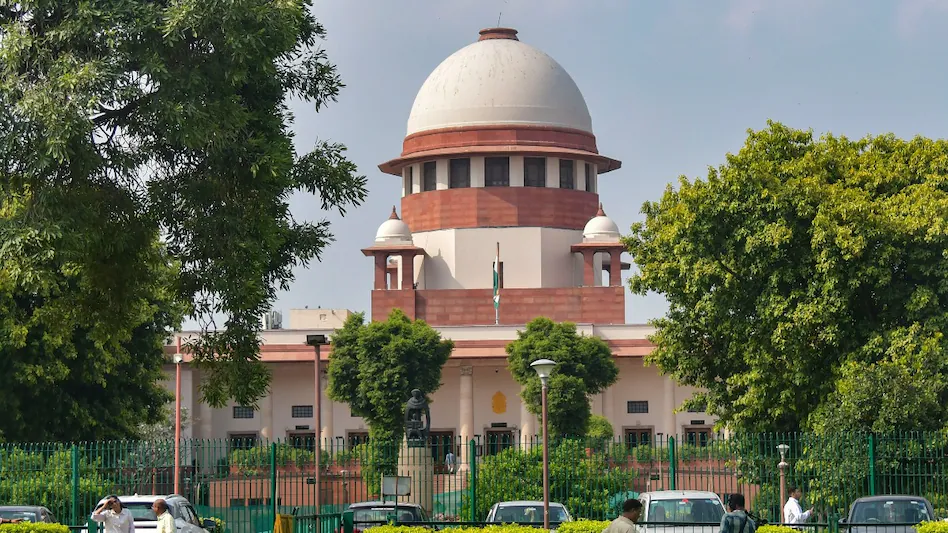
New Delhi: The Supreme Court on Thursday expressed strong displeasure over the Centre’s request to defer the hearing on multiple petitions — including one filed by the Madras Bar Association — challenging the constitutional validity of the Tribunals Reforms (Rationalisation and Conditions of Service) Act, 2021.
A bench headed by Chief Justice B.R. Gavai had earlier taken exception to the Centre’s move seeking to refer the matter to a five-judge Constitution Bench, remarking that such a request at the final stage of hearings was unexpected.
The 2021 law abolished certain appellate tribunals — including the Film Certification Appellate Tribunal — and altered provisions related to the appointment, tenure, and service conditions of members across various tribunals.
During Thursday’s proceedings, Additional Solicitor General Aishwarya Bhati sought an adjournment on behalf of Attorney General R. Venkataramani, citing his international arbitration commitments.
This drew a sharp response from the CJI: “Very unfair to the court. We have accommodated him twice already. This is not fair.”
When Bhati suggested listing the matter on Monday, the visibly irked CJI replied, “When do we write the judgment then? Every day we are told he’s busy with arbitration. At the last moment, you come with an application to refer the matter to a Constitution Bench!”
The CJI questioned why another law officer could not represent the Union, pointing out, “You have a battery of competent ASGs. We even cleared our Friday schedule to conclude the hearing and use the weekend to prepare the judgment.”
Ultimately, the bench decided to hear senior advocate Arvind Datar, representing the Madras Bar Association, on Friday and accommodate the Attorney General’s arguments on Monday. “If he does not come, we will close the matter,” the CJI warned.
The bench, also comprising Justice K. Vinod Chandran, has already heard final arguments from the petitioners. The court was particularly displeased that the Centre sought to refer the case to a larger bench after arguing it on merits. “You cannot raise such objections after full hearings. We do not expect the Union to indulge in such tactics,” the CJI remarked, suggesting the government was attempting to avoid the current bench.
The Supreme Court had begun its final hearing on October 16.
Earlier, Datar recalled that in July 2021, the apex court had struck down several provisions of the Tribunal Reforms Ordinance, holding that they violated judicial independence and separation of powers. Yet, the Centre later enacted the Tribunal Reforms Act, reintroducing the same provisions verbatim, despite the court’s ruling.
The previous verdict had invalidated clauses reducing the tenure of tribunal members and chairpersons to four years, stressing that such short terms could compromise judicial independence. The court held that the tenure should be five years, with an upper age limit of 70 years for chairpersons and 67 years for members.
It had also quashed the minimum age requirement of 50 for appointments, reasoning that younger members would ensure a more dynamic tribunal system, and reaffirmed that 10 years of legal practice was sufficient for judicial appointments, aligning the standard with that of High Court judges.
Additionally, the apex court had struck down the government’s power to appoint from a shortlist of two names recommended by the Search-cum-Selection Committee.
Despite this, the Centre went ahead and passed the Tribunals Reforms Act in August 2021, with provisions almost identical to those that had already been struck down — a move the Supreme Court is now re-examining.