






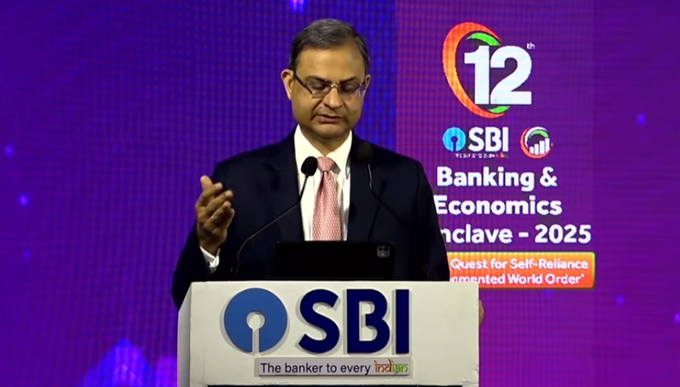
Mumbai: Reserve Bank of India (RBI) Governor Sanjay Malhotra on Friday said that while the central bank continues to act with “caution,” the need to “show courage” has prompted recent easing of certain banking regulations.
Speaking at an event organised by the State Bank of India (SBI), Malhotra clarified that the additional responsibilities placed on banks stem from improved governance and stronger performance across the financial system. He stressed that the RBI has sufficient tools to address any irregularities in the sector.
Malhotra underlined that the RBI does not intend to micromanage institutions, noting that “no regulator can or should replace boardroom judgment.” Each case, he said, must be assessed on its own merits.
Last month, the central bank introduced several measures — including allowing banks to fund domestic acquisitions and permitting foreign borrowings for the real estate sector.
Since taking charge, Malhotra has focused on improving the ease of doing business and factoring in the regulatory cost before rolling out new policies. “While we move with caution, we need to display courage,” he said, explaining the philosophy behind the latest initiatives.
He cautioned against compromising financial stability for short-term gains, saying it could harm long-term growth. The RBI, he added, must balance economic interests with prudence. “Promoting efficiency and innovation is part of our duty,” Malhotra said, acknowledging that regulation, like stability, comes with costs.
The recent policy changes, he clarified, are incremental and not a radical shift in banking norms. “These measures are balanced and appropriate, built on the foundation of a system fortified over the past decade, with financial stability as the cornerstone,” he said.
Quoting Shakespeare’s Romeo and Juliet, Malhotra remarked that the RBI would “go wisely and slow,” as rushing could lead to stumbles. Comparing the regulator’s role to that of a gardener, he said the central bank must guide growth while pruning excesses to maintain “a collective, orderly, and beautiful garden.”
The governor highlighted the RBI’s toolkit — such as adjusting risk weights, modifying provisioning norms, and using counter-cyclical buffers — to contain emerging risks. He cited the November 2023 increase in risk weights on unsecured loans as an example of proactive action.
The central bank can also use supervisory measures to check unsustainable growth, Malhotra said, adding that many recent initiatives are still in draft form and will be finalised after public feedback.
On easing financing rules, he noted that the move to allow acquisition financing will support the real economy, with safeguards like limiting bank funding to 70% of the deal value.
Malhotra described the liberalisation of external commercial borrowing as a “natural step” in India’s financial evolution, backed by strong capital inflows and a stable external sector. He added that the RBI expects these inflows to remain robust through the fiscal year.
Clarifying on allowing real estate companies to raise funds from abroad, he said such borrowings are restricted to FDI-compliant projects and remain barred for speculative or land purchase activities.
Malhotra concluded by emphasising that the RBI is working toward a more transparent, data-driven, and consultative rule-making process, ensuring all policy decisions are informed by evidence and stakeholder feedback.