






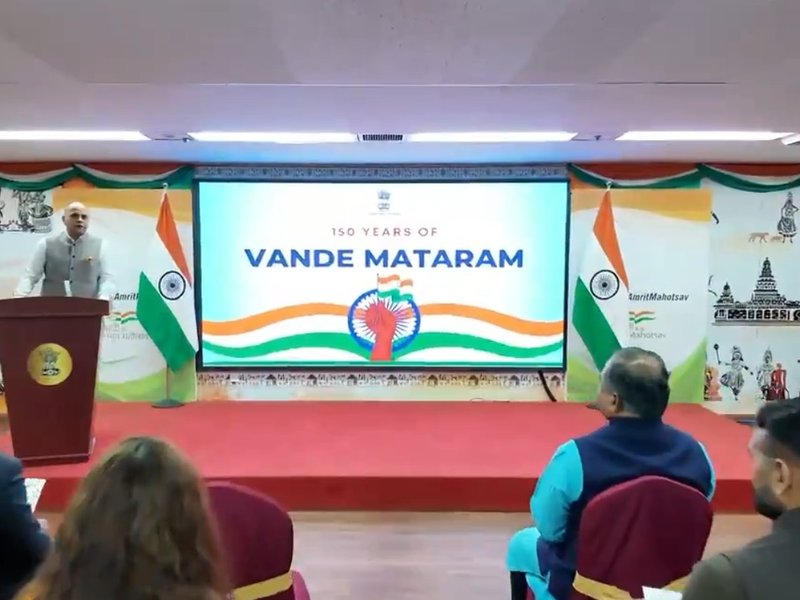
Shanghai: Indian Community Marks 150 Years of Vande Mataram
The Indian community in Shanghai commemorated 150 years of India’s national song Vande Mataram on Friday with a vibrant celebration at the Consulate General of India. The event began with an address by Consul General Pratik Mathur, who reflected on the song’s powerful role in inspiring India’s freedom movement.
Sharing glimpses from the event on X, the Consulate wrote:
“Goonj of Vande Mataram in China! Celebrating 150 years of Vande Mataram in Shanghai — honouring the song that awakened a nation and continues to unite it today. The event opened with a stirring address by CG Pratik Mathur on the song’s role in igniting India’s freedom struggle. The Consulate auditorium echoed with voices singing Vande Mataram in unison, marking 150 years of the anthem that defined India’s independence journey.”
The Consulate also recalled Shanghai’s historical connection with India’s freedom struggle:
“Shanghai holds a special place in this history — once a secret hub for Ghadar revolutionaries who dreamt of India’s freedom from these shores. It’s the city where Gurudev Rabindranath Tagore visited in 1924 and 1929 to awaken Asian unity. From whispers of revolution then to a proud chorus now — the spirit lives on! Jai Hind!”
Earlier in the day, Prime Minister Narendra Modi launched the year-long national commemoration of Vande Mataram’s 150th anniversary at New Delhi’s Indira Gandhi Indoor Stadium.
Speaking at the inauguration, PM Modi said Vande Mataram became “the voice of India’s awakening” during the colonial era — a rallying cry for freedom and self-determination.
“Even in times of despair, Bankim Chandra Chatterjee envisioned a prosperous India,” the Prime Minister said. “He believed that no matter how difficult the times, India would revive its golden age — that is why he invoked the call of Vande Mataram.”
Composed by Bankim Chandra Chatterjee on Akshaya Navami, November 7, 1875, Vande Mataram first appeared in his literary journal Bangadarshan as part of the novel Anandamath. The song reveres the motherland as a symbol of strength, prosperity, and divinity — and over time, became an enduring expression of India’s unity and national pride.