







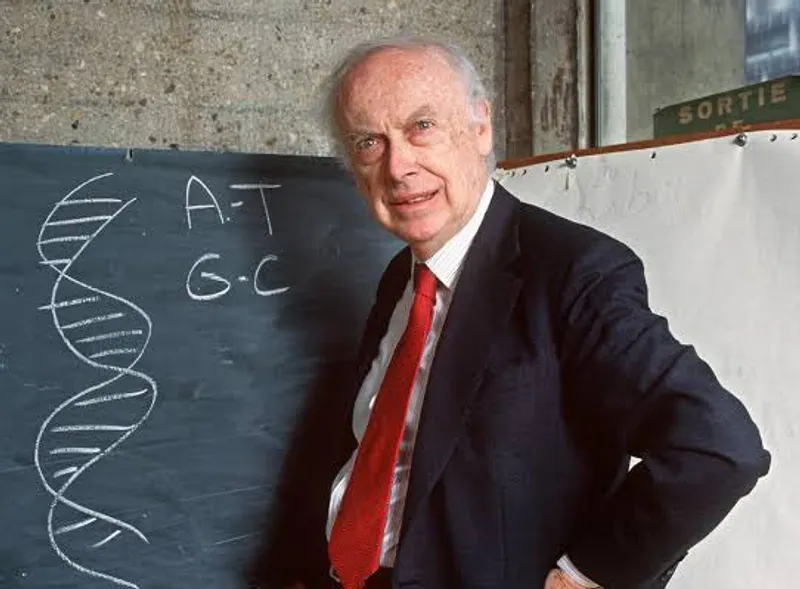
New Delhi: “We have discovered the secret of life,” declared American scientist James Watson in 1962, when he, along with Maurice Wilkins and Francis Crick, received the Nobel Prize in Physiology or Medicine for unveiling the double helix structure of DNA — one of the greatest scientific breakthroughs of the 20th century.
Watson, a renowned geneticist, passed away at the age of 97, as confirmed by Cold Spring Harbor Laboratory (CSHL) in the US, where he spent decades conducting pioneering research.
Although DNA was first identified in 1869, it wasn’t until 1943 that scientists discovered it to be the carrier of genetic material in cells — a mystery that the trio later helped unravel.
Watson died on Thursday (US time) after a brief illness, according to a statement from CSHL.
“I think early on, I wanted to do something important with my life. I still want to think about science and really nothing else,” Watson told CNN in 2013. Reflecting on his life’s work, he added, “Being driven by the desire to find the truth — that’s really my legacy. The truth is complicated, but starting with it is always helpful.”
Born in Chicago in April 1928, Watson earned a scholarship to the University of Chicago at just 15. He later moved to Cambridge University in England to study DNA structure, where he met Crick, and together they began building models to visualize DNA’s composition.
In 1968, Watson became director of Cold Spring Harbor Laboratory, transforming it into one of the world’s leading research centers.
However, his career was not without controversy. His legacy was clouded by racist and homophobic remarks suggesting genetic differences among groups, leading to the revocation of several honorary titles.
Watson also made headlines in 2014 when he auctioned his Nobel Prize for $4.76 million. Reflecting on his life’s pursuit, he once said: