






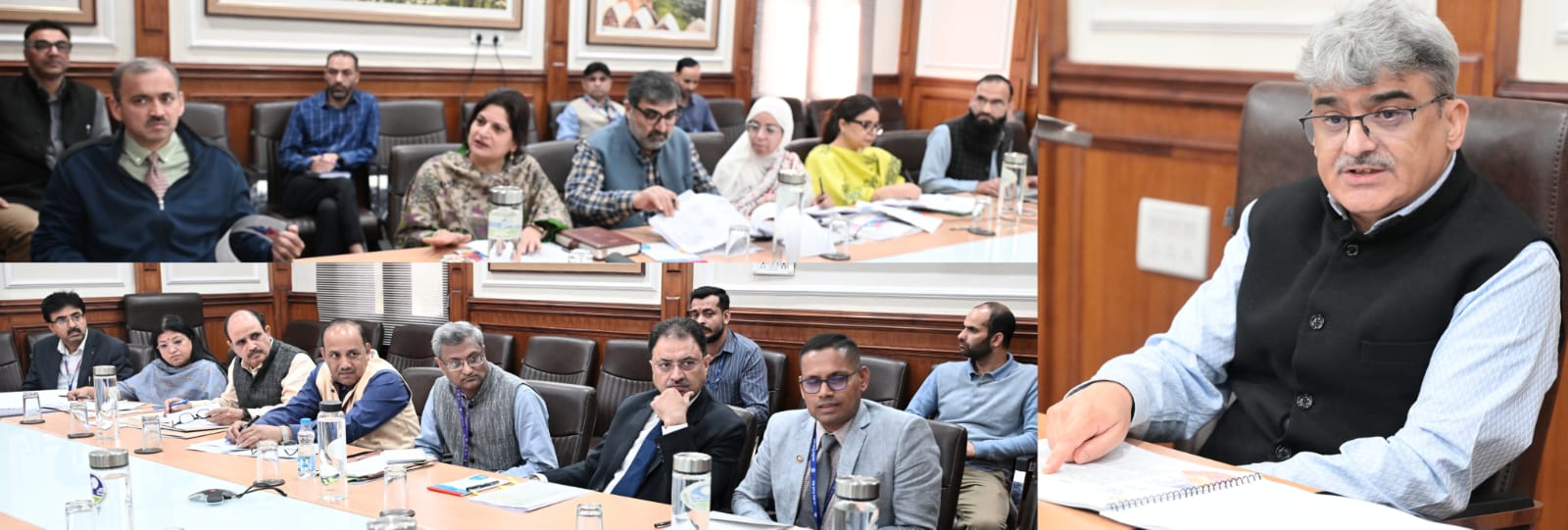
Chief Secretary Atal Dulloo Reviews Performance of Cooperative Department, Calls for Strengthening Rural Financial Ecosystem
JAMMU: Chief Secretary Atal Dulloo today chaired a high-level meeting to review the performance of the Cooperative Department and assess progress in promoting cooperative activities and financial reforms across Jammu and Kashmir.
The meeting was attended by Principal Secretary, Finance; Commissioner Secretary, Cooperatives; Regional Director, RBI; Managing Director, J&K Bank; Director General, Budget; Registrar, Cooperative Societies; representatives from NABARD and other financial institutions, along with senior departmental officers.
At the outset, the Chief Secretary underscored the vital role of cooperative institutions in driving rural development and directed the department to transform Cooperative Societies into Common Service Centres (CSCs) to expand their service outreach. He emphasized the need to run these societies on sound business models, enabling diversification into sectors such as the sale of seeds, seedlings, cattle and poultry feed, and fisheries supplies.
He further asked the department to explore collaboration with the Ayush Department for vending wellness products and installing vending machines at high-footfall locations. Stressing the importance of strengthening financial sustainability, he called for enhanced credit linkages for cooperative entities and professional management of their operations.
While reviewing the financial health of cooperative banks and Super Bazars, Dulloo instructed J&K Bank to extend advisory support to cooperative banks in addressing Non-Performing Assets (NPAs) and other financial issues in a transparent and legally sound manner. He also directed the constitution of a panel of retired bankers of high integrity, in consultation with RBI, to assist in appointing Managing Directors and professional management teams to bring in modern, performance-driven governance.
Commissioner Secretary, Cooperatives, Babila Rakwal, informed that J&K’s cooperative sector is undergoing a significant transformation through the adoption of the Multi-Purpose Primary Agricultural Credit Societies (M-PACS) model and various reform initiatives aimed at growth and financial stability. All 537 PACS have adopted common byelaws to function as M-PACS, enabling diversification into allied sectors such as dairy, fisheries, and horticulture.
She further informed that the computerization of PACS is progressing swiftly, with all 537 societies completing the Dynamic Day-End process and now operating as e-PACS. Each PACS has availed a 40-year term loan of ₹63,000 for hardware and software upgrades under the digital transformation plan.
Highlighting citizen service integration, it was revealed that 515 PACS are functioning as Common Service Centres (CSCs) with a monthly transaction value of ₹3.10 lakh, while 154 PACS have been upgraded as Pradhan Mantri Kisan Samman Nidhi Kendras (PMKSKs) to provide agricultural services.
Under White Revolution 2.0, the cooperative sector has achieved remarkable growth with the formation of 2,232 Dairy Cooperative Societies (DCSs), out of which 1,692 have been strengthened, benefitting over 1.06 lakh women members. The initiative has boosted milk procurement to 3 lakh litres per day through these societies.
Additionally, several M-PACS are running Pradhan Mantri Jan Aushadhi Kendras (PMJAKs) to provide affordable medicines in remote areas. So far, 52 drug licenses and 50 medical stores have been operationalized, generating a monthly transaction value of ₹8.78 lakh.
The J&K State Cooperative Bank has adopted modern banking technologies including migration to Finacle 10, automation of loan schemes, and enhanced financial literacy initiatives.
Meanwhile, the Super Bazar chain has shown steady improvement, clearing ₹4 crore in GST dues (FY 2020–21) and settling ₹28 lakh in gratuity and CPF dues of former employees. Currently, 16 PACS have been enrolled as new Super Bazar outlets, with a renewed focus on capacity building, marketing, and urban market expansion.
Concluding the meeting, the Chief Secretary emphasized the need to sustain momentum toward professionalization, digital empowerment, and grassroots financial inclusion through a robust cooperative movement in Jammu and Kashmir.