






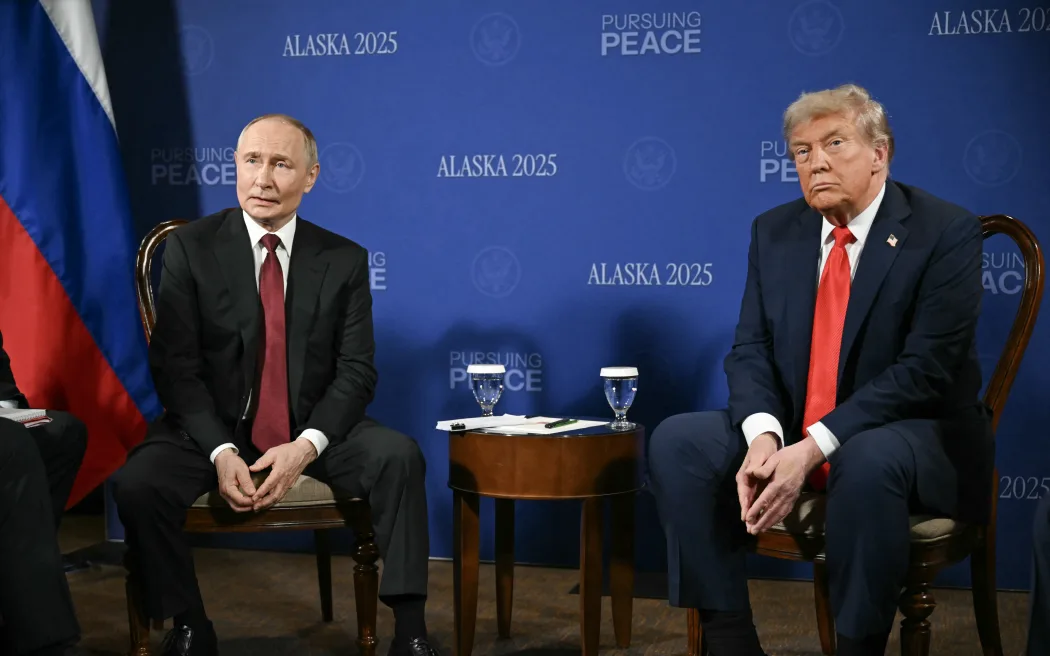
Anchorage: President Donald Trump failed on Friday to secure an agreement from Vladimir Putin to end Russia’s war in Ukraine, falling short of his most high-profile attempt to halt the conflict—even after rolling out a red-carpet welcome for the Russian leader.
“There’s no deal until there’s a deal,” Trump said, responding to Putin’s claim that they had reached an “understanding” on Ukraine and his warning to Europe not to “torpedo the nascent progress.” Trump added that he would brief Ukrainian President Volodymyr Zelenskyy and European leaders on the talks.
Trump, who has long questioned U.S. support for Ukraine and expressed admiration for Putin, had promised to end the war from the moment he returned to the White House. Seven months later, after criticizing Zelenskyy and limiting some U.S. military aid to Kyiv, Trump could not convince Putin to even pause the fighting, as Russian forces continued to advance.
The U.S. president offered both incentives and threats, combining a warm welcome at Joint Base Elmendorf-Richardson in Anchorage with warnings of potential economic sanctions. Yet he left without any tangible progress toward ending the war, now in its fourth year.
Instead, Putin received a long-sought boost on the international stage, breaking the Western strategy of isolating him over the war and his crackdown on dissent. The two leaders concluded a joint appearance without taking questions from the press, signaling the talks fell short of Trump’s goals.
In a Fox News interview after leaving Alaska, Trump suggested that Zelenskyy—and European nations—would bear responsibility for moving the process forward, highlighting Zelenskyy’s absence from the meeting. Trump sought to showcase his deal-making skills, while Putin aimed to secure Russia’s gains, block Ukraine’s NATO ambitions, and bring the country closer to Moscow.
Standing next to Putin, Trump said, “We had an extremely productive meeting, and many points were agreed to. There are just a few left. Some are not that significant. One is probably the most significant, but we have a very good chance of getting there. We didn’t get there.”
For Putin, being on U.S. soil for the first time in over a decade validated him after years of international ostracism. The meeting may delay further U.S. sanctions and could lead to additional discussions, giving Russian forces more time to advance. Putin called for renewed cooperation and praised Trump for understanding both U.S. and Russian national interests.
Despite the lack of a breakthrough, Trump ended by thanking Putin, hinting at a possible future meeting. Putin responded, “Next time in Moscow,” to which Trump replied cautiously, saying it was “an interesting one” but might draw criticism.
During the Fox News interview, Trump also noted that Putin echoed many of his longstanding grievances, including about the 2020 election, suggesting Trump may have left Alaska feeling he had achieved a symbolic victory despite no concrete results.
The leaders’ arrival in Alaska was marked by a warm handshake, extended hand-holding, and a short ride in the U.S. presidential limo, while military aircraft flew overhead—a display of cordiality unusual given the ongoing war in Ukraine. While reflecting their longtime friendly relationship, the display likely raised concerns for Zelenskyy and European leaders, who worry Trump prioritized U.S. interests over pressuring Russia.
The originally planned one-on-one meeting became a three-on-three discussion, including Secretary of State Marco Rubio and special envoy Steve Witkoff, with Putin joined by Foreign Minister Sergey Lavrov and adviser Yuri Ushakov—a more guarded approach than Trump’s private 2018 meeting in Helsinki. Zelenskyy’s exclusion also undermined the Western principle of “nothing about Ukraine without Ukraine.”
The conflict continues with heavy losses on both sides. Ukraine, though holding on longer than expected since Russia’s February 2022 invasion, faces immense pressure against a larger Russian army along a 600-mile (1,000-kilometer) front.
Alaska, just three miles from Russia at its closest point, is home to Joint Base Elmendorf-Richardson, historically critical during the Cold War and still active in intercepting Russian aircraft entering U.S. airspace.