






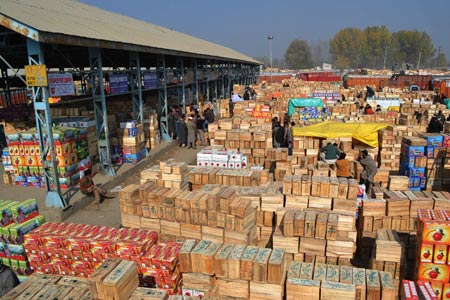
Jammu: The nearly month-long closure of the Jammu-Srinagar national highway has severely disrupted supply between the two divisions of Jammu and Kashmir, leading to a steep fall in apple prices at the Jammu fruit mandi.
With truckloads of apples delayed for days, much of the produce is arriving in poor condition, forcing traders to sell at heavily reduced rates. Both growers and traders are facing huge financial losses, sparking fears over the stability of the region’s apple trade amid ongoing transport bottlenecks.
The 270-km highway, the only all-weather road connecting Kashmir with the rest of the country, suffered extensive damage—particularly between Nashri and Udhampur—after record rainfall on August 26–27, bringing traffic to a standstill. Although the road was partially reopened last week, hundreds of trucks carrying apples remained stranded, causing extensive spoilage.
“This is a very difficult period for everyone. The road has done more damage than the rain. Some trucks that left Kashmir on September 1 are reaching only today (September 16),” said Sandeep Mahajan, a trader at Narwal Mandi, Jammu’s main fruit and vegetable hub. He noted that this is peak apple season and urged the government to step in to minimise losses.
“What survival rate can perishable goods have if it takes a fortnight to reach Jammu? Nearly 60% of the produce is spoiled, forcing us to sell at throwaway prices,” Mahajan added. He dismissed the recently introduced freight train from Budgam to Delhi via Jammu as an inadequate alternative, citing limited capacity and poor coverage of south Kashmir’s orchards.
Trader Randeer Gupta said they are facing near-total losses. “We will not recover more than five per cent of what we invested. Boxes worth ₹1,000 are being sold for just ₹100–200. Trucks are taking over 10 days to reach,” he said.
He added that many traders had invested heavily, hoping to recover from past setbacks, but “this time both growers and traders are ruined.”
Veteran trader Manik Gupta, with five decades in the business, described the situation as unprecedented. “We have seen ups and downs, but never total destruction like this. Nearly 60% of the crop is gone. Farmers are now reluctant to even load their produce because of the heavy losses,” he said.
He pointed out that the damage has extended beyond growers to traders, who had already paid more than half the amount in advance—many by taking loans or putting in their entire savings.
“The apple season lasts three months. The government must ensure smooth transportation of horticulture produce, the backbone of J&K’s economy. Controlled atmosphere stores in Kashmir are already full, so the priority must be unhindered road connectivity,” Gupta stressed.