






Mumbai: A major milestone was achieved on Saturday morning for the Mumbai-Ahmedabad bullet train project with the breakthrough of a 4.88 km-long tunnel between Shilphata and Ghansoli. Railway Minister Ashwini Vaishnaw, who presided over the event, called it a “landmark achievement.” He said the first phase of the high-speed corridor on the Surat-Bilimora section is scheduled to begin in December 2027.
Addressing reporters in Ghansoli near Mumbai, Vaishnaw said the bullet train will be “transport for the middle class” with “reasonable” fares. He noted that while Google Maps estimates the journey between Mumbai and Ahmedabad at nine hours, the bullet train will cover the distance in just two hours and seven minutes.
The first phase will launch on the Surat-Bilimora section in 2027, followed by Thane in 2028 and the Bandra Kurla Complex in 2029. “During morning and evening peak hours, trains will depart every half hour. Once the network stabilizes, trains will run every 10 minutes during peak times,” he added. Passengers traveling between Mumbai and Ahmedabad will not need ticket reservations and can board directly at the station.
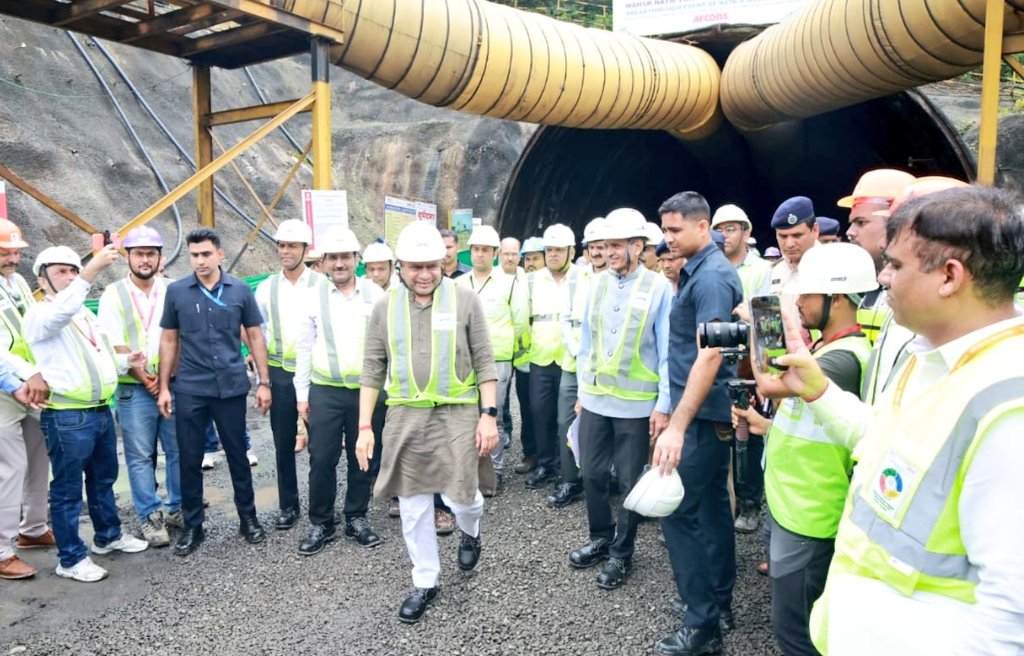
At the tunnel site, Vaishnaw triggered a controlled dynamite blast, completing the excavation of the 5 km stretch. The National High-Speed Rail Corporation Limited (NHSRCL) said the tunnel, constructed using the New Austrian Tunneling Method (NATM), forms part of the 21 km underground segment between the Bandra-Kurla Complex (BKC) and Shilphata, including a 7 km portion under Thane Creek.
With this breakthrough, the tunnel now connects the Savali shaft to the Shilphata portal, linking it to the viaduct section of the Mumbai-Ahmedabad High-Speed Rail (MAHSR) project. Tunnel excavation began in May 2024 in three phases, with the first 2.7 km continuous section completed on July 9. An additional intermediate tunnel (ADIT) enabled simultaneous excavation from both Ghansoli and Shilphata sides.
The NATM tunnel, 12.6 metres wide internally, was constructed using drilling, blasting, surveying, and support systems under challenging geological conditions. The next phase will focus on waterproofing, lining, finishing, and equipment installation, while the remaining 16 km of tunneling will be completed using tunnel boring machines (TBMs). Once finished, the tunnel will be a single-tube, 13.1-metre diameter structure accommodating twin tracks for both directions.
The NHSRCL emphasized comprehensive safety measures, including settlement markers, piezometers, inclinometers, strain gauges, restricted site access, and fresh air supply for workers inside the tunnel.
The 508 km-long Mumbai-Ahmedabad high-speed rail corridor is India’s first bullet train project. So far, 321 km of viaduct, 398 km of piers, 17 river bridges, nine steel bridges, and over four lakh noise barriers across 206 km have been completed. Track bed construction has been finished for 206 km, with more than 2,000 overhead equipment masts installed along 48 km of the mainline viaduct.