






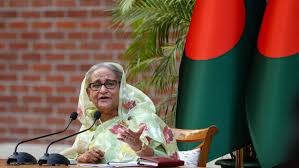
DHAKA: Bangladesh’s interim government has issued a stern warning to media outlets against broadcasting or publicising statements by Awami League leader and ousted prime minister Sheikh Hasina, threatening immediate legal action against any violations.
A statement from Chief Adviser Muhammad Yunus’s press wing said, “We warn media officials involved in such unlawful dissemination and firmly inform all that any circulation of Sheikh Hasina’s statements in the future will invite instant legal action.”
The announcement described airing Hasina’s audio or speeches on television, news channels, or online portals as a “serious violation of the Anti-Terrorism Act 2009,” and referred to her as “a convicted criminal and fugitive accused of mass killings and crimes against humanity.”
Sheikh Hasina, removed from office in a street movement on August 5, 2024, is currently being tried in absentia at the International Crimes Tribunal on multiple charges, although no convictions have been handed down yet. Her supporters argue that the charges are politically motivated. In December, the tribunal had already prohibited the broadcasting of her statements.
The interim government noted that some media outlets defied this ban by airing a speech of Hasina on Thursday. The statement added, “At this crucial moment in our nation’s history, we cannot risk creating unnecessary confusion.”
It further claimed, “Sheikh Hasina fled Bangladesh after being accused of ordering the massacre of hundreds of peaceful protesters during the July uprising.”
Highlighting preparations for upcoming elections, the government emphasized its commitment to guiding Bangladesh towards justice, accountability, and democratic integrity. “For the first time in generations, the people of Bangladesh are preparing for truly free and fair elections,” the statement said, urging media outlets to exercise restraint in broadcasting content that could incite instability or violence.
Earlier this month, Yunus confirmed that elections would be held in February, with the Election Commission scheduling the polls for the first week of that month.
In Awami League’s absence, the Bangladesh Nationalist Party (BNP) has emerged as the largest party after the interim government dissolved its activities through an executive order.
Additionally, an offshoot of Students Against Discrimination (SAD), which had previously led protests against Hasina, established the National Citizen Party (NCP) in February, reportedly with Yunus’ support. The NCP is believed to have formed alliances with far-right Jamaat-e-Islami and other Islamist groups opposed to the BNP.
Despite repeated assurances from Yunus and his advisers about free and fair elections, political uncertainty has persisted due to the actions and statements of the NCP.