






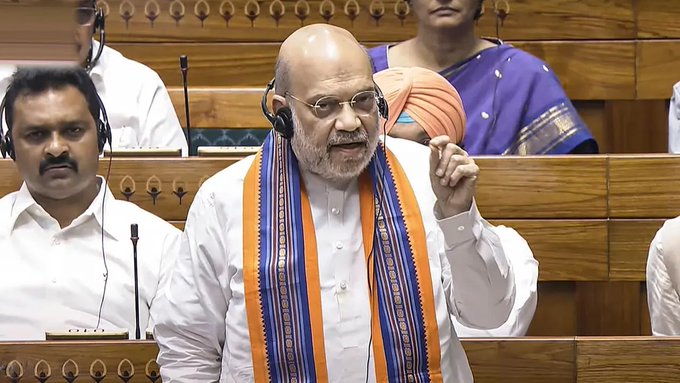
New Delhi: Union Home Minister Amit Shah on Wednesday introduced three Bills in the Lok Sabha seeking removal of the prime minister, chief ministers and ministers if they remain in custody for 30 days on serious criminal charges. The move triggered sharp protests from the Opposition as the draft laws were referred to a Joint Committee of Parliament.
Amid repeated disruptions, the House adopted by voice vote a resolution to send the Bills to the Joint Committee, which will include 21 members from the Lok Sabha and 10 from the Rajya Sabha. The panel has been asked to submit its report by the end of the first week of the next (Winter) session, likely in November.
As the Bills were tabled, Opposition MPs trooped into the Well, raised slogans, and some even tore copies of the draft. Leaders including AIMIM’s Asaduddin Owaisi and Congress’ Manish Tewari and K C Venugopal opposed the legislation, calling it unconstitutional and against federal principles. Shah, however, dismissed the criticism, stressing that the Joint Committee would allow all parties, including the Opposition, to give suggestions.
Responding to Venugopal’s remarks on his past arrest as Gujarat home minister, Shah countered that he had resigned before his arrest and returned to office only after being acquitted. “We cannot be so shameless that we continue to occupy constitutional positions while facing serious charges,” he said.
The uproar forced Speaker Om Birla to adjourn the House till 5 pm. Earlier, amid heated exchanges between ruling and Opposition MPs, Union Ministers Ravneet Singh Bittu and Kiren Rijiju intervened to shield Shah, while House marshals formed a protective ring around him. Even after adjournment, the Opposition continued sloganeering.
The three Bills introduced are:
- The Government of Union Territories (Amendment) Bill, 2025
- The Constitution (One Hundred and Thirtieth Amendment) Bill, 2025
- The Jammu and Kashmir Reorganisation (Amendment) Bill, 2025
Under the proposals, if the prime minister, a Union minister, or a chief minister is arrested and detained for 30 consecutive days on charges carrying a minimum five-year jail term, they would automatically lose office on the 31st day.
Owaisi argued the changes would be used to “destabilise governments,” while Tewari said the move violated the principle of “innocent until proven guilty.” He warned it could distort parliamentary democracy and open doors to political misuse. RSP’s N K Premachandran also objected, calling the introduction of the Bills “unduly hasty” and procedurally flawed.
Currently, the Government of Union Territories Act, 1963, has no provision for removal of a chief minister or minister facing such circumstances. The new Bills seek to amend Section 45 of the Act to provide a legal framework for their removal.