







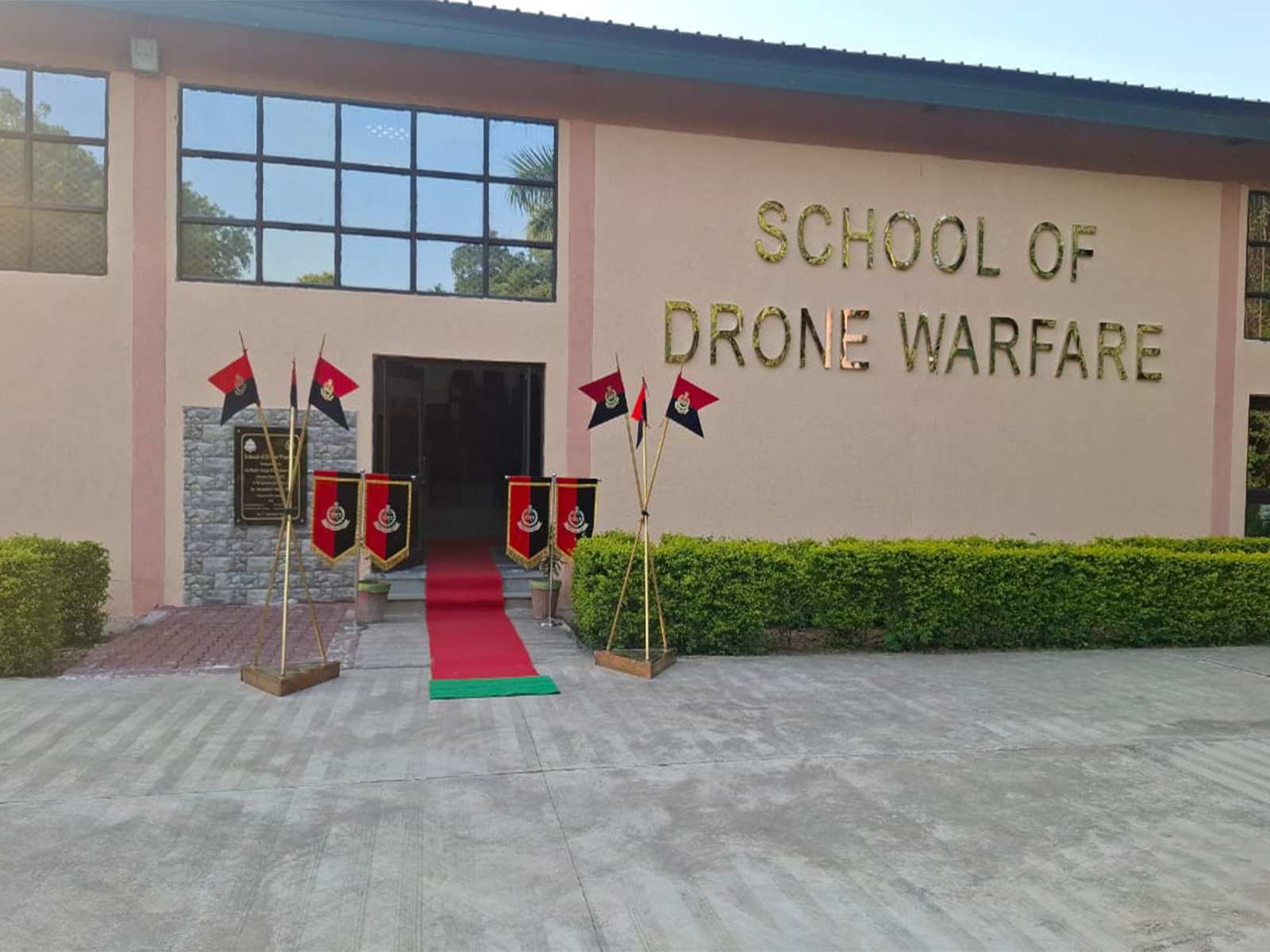
Tekanpur: BSF Launches India’s First Drone Warfare School to Counter Emerging Border Threats
In response to evolving threats along India’s borders following Operation Sindoor, the Border Security Force (BSF) has set up the country’s first dedicated Drone Warfare School at its training academy in Tekanpur, Madhya Pradesh. The school aims to enhance the force’s offensive and defensive unmanned aerial capabilities.
Established last month, the inaugural batch of 40 officers completed a week-long “drone orientation” course, including Commandant and Second-in-Command level officials from all BSF frontiers and Subsidiary Training Centres (STCs). A second batch of 47 personnel, comprising Subordinate Officers, Assistant Sub-Inspectors, and Constables, is currently enrolled in the six-week “Drone Commando Course.”
The curriculum covers drone piloting, tactical operations, research and development (R&D), and countering drone-enabled smuggling and emerging threats. The initiative is the brainchild of Shamsher Singh, Additional Director General (ADG) and Director of the BSF Academy, Tekanpur.
“The force has faced drone-enabled narcotics and weapons smuggling for the past four to five years, with challenges taking new forms post-Operation Sindoor. To meet these effectively, we established the Drone Warfare School last month,” ADG Singh said.
The school operates through three wings: Flying and Piloting, Tactics, and R&D, with the tactics wing focusing on integrated offensive and defensive operations. “Two flagship courses—Drone Commando and Drone Warrior—prepare personnel for rapid drone assembly, flying, repairs, weaponisation, and counter-drone operations,” Singh added.
“The Drone Commando course is designed so personnel can assemble a drone in just 50 seconds, similar to how commandos handle weapons. The curriculum is based on a detailed analysis of five years of border incidents, including forensic studies of technologies used by smugglers and hostile actors,” he said.
Courses also cover defending against rogue drones, neutralising enemy drones, and integrating drone patrols into broader border-management operations, with an eye on future deployment along sensitive frontier stretches. Singh highlighted that the training aligns with broader strategic shifts, including preparation for cyber and hybrid warfare.
BSF Inspector General Umed Singh noted that drone warfare has emerged as a critical domain, evidenced in the Russia-Ukraine conflict. “After Operation Sindoor, heavy drone activity along the western border underscored the need for counter-drone training and integrated defence systems, including spoofers, jammers, and both soft- and hard-kill solutions,” he said.
Brigadier Rupinder Singh, BSF Academy instructor, emphasized that courses provide hands-on flying skills, tactical deployment, and technical understanding of drones and counter-drone systems. Trainees study case examples from global conflicts and learn to adapt to the evolving role of drones in modern warfare.
“With drones, even trenches offer limited protection. Our training updates both tactical and technical competencies to meet these shifts,” Brigadier Singh said. He added that the BSF has procured jammers and radar trainers, with further systems acquisition planned at an estimated cost of ₹20 crore.
Manoj Painuli, Second-in-Command and Specialist Drone Instructor, explained that exercises such as “Drone Vajra” simulate border conditions similar to Jammu and Punjab, enabling trainees to plan missions while factoring in environmental influences like wind, sun-angle, and electromagnetic interference.