






Stresses Speedy Completion and Early Commissioning of Prestigious Project
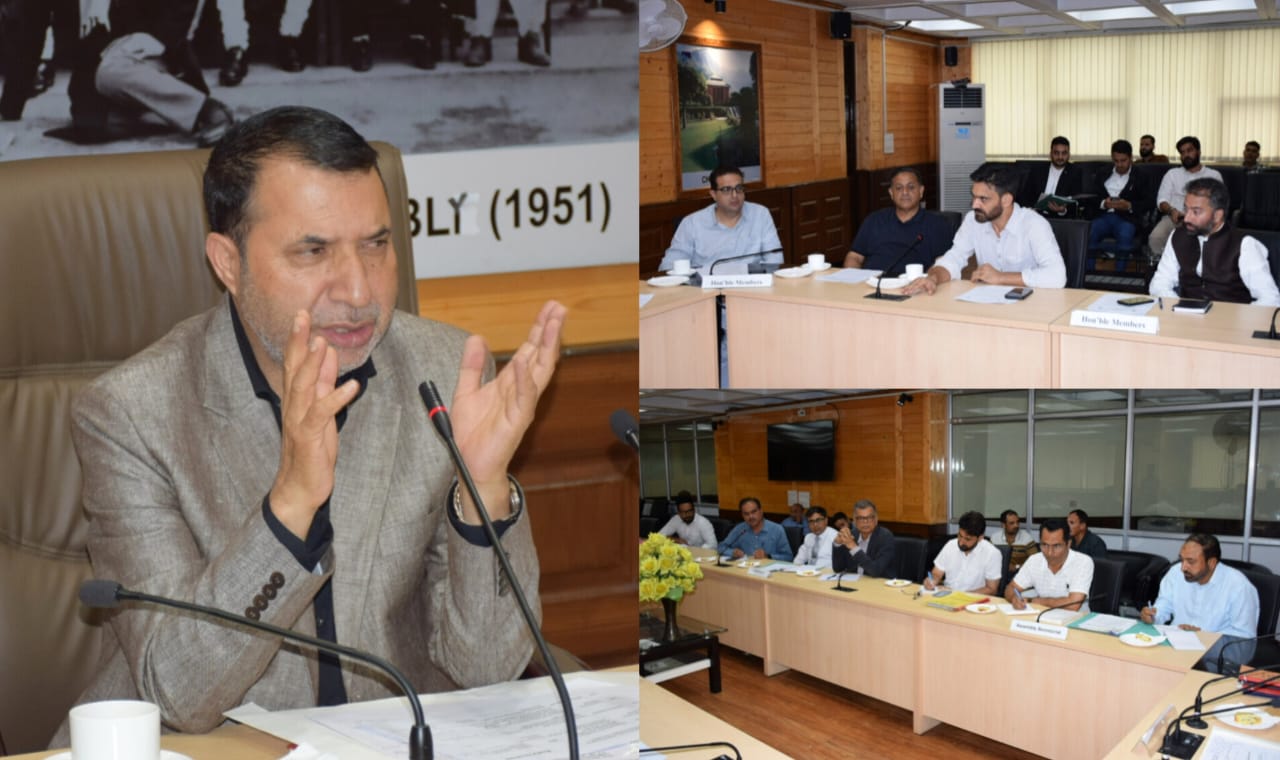
SRINAGAR: The House Committee on Petitions of the Jammu and Kashmir Legislative Assembly convened today at the Assembly Complex, Srinagar, to review the progress of the All India Institute of Medical Sciences (AIIMS), Awantipora.
The meeting was chaired by Committee Chairman Pirzada Farooq Ahmad Shah, with members Mushtaq Guroo, Salman Sagar, Waheed u Rehman Para, Mian Mehar Ali, and Thakur Randhir Singh in attendance.
The session began with a detailed review of infrastructure development, machinery procurement, workforce deployment, and other allied works at the AIIMS project site. Chairman Shah emphasized the need for strict adherence to timelines to ensure the timely commissioning of this landmark project.
“This project holds immense significance for the people of Kashmir and must be completed at the earliest to serve their convenience and benefit,” he remarked. The Chairman directed concerned authorities to expedite all pending works and ensure their completion within set deadlines.
The Committee highlighted that AIIMS Awantipora should be commissioned as a fully integrated unit, with all facilities—including OPD and IPD services—operational simultaneously for the public. He also announced that the Committee would conduct on-site inspections to monitor work quality and progress.
Executive Director AIIMS, Dr. S. Mohanty, briefed the Committee on the current status, stating that MBBS courses are expected to begin in July 2026, while OPD and IPD services are likely to be operational by the end of the same year.
In addition, the Committee discussed various other matters raised through petitions. Members underlined that each petition would be carefully reviewed to ensure appropriate redressal. The Chairman stressed that officers must submit detailed reports on issues related to their departments, warning that failure to do so would be treated as non-compliance.
The discussions focused on devising practical, effective, and time-bound solutions to citizens’ grievances, with members actively providing constructive suggestions and feedback.