






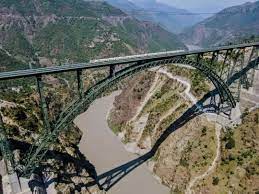
New Delhi – The Lok Sabha was informed on Wednesday that to minimize environmental disturbance in the fragile Himalayan region, special care was taken during the execution of the Udhampur-Srinagar-Baramulla Rail Link (USBRL), including the iconic Chenab and Anji bridges. Top national and international institutions were involved to ensure slope stabilization and ecological protection.
Responding to queries on environmental impact assessments (EIAs) of the Chenab and Anji Khad bridges, Railway Minister Ashwini Vaishnaw provided a detailed account of the measures undertaken to safeguard the environment throughout the USBRL project.
The 272-km USBRL, recently completed, spans several districts in Jammu and Kashmir, including Udhampur, Reasi, Ramban, Srinagar, Anantnag, Pulwama, Budgam, and Baramulla.
“This is one of the most challenging railway projects undertaken post-independence,” said Vaishnaw. “The alignment traverses the young Himalayan terrain, known for its complex geology and numerous engineering challenges.”
The minister highlighted the engineering feats of the project, noting that it includes the world’s highest railway bridge over the Chenab River in Reasi. The Chenab Bridge is 1,315 meters long, with an arch span of 467 meters and a height of 359 meters above the riverbed. The Anji Khad bridge, India’s first cable-stayed railway bridge, features a deck 331 meters above the river and a main pylon 193 meters tall.
On the project’s social impact, Vaishnaw said that it has significantly boosted local socio-economic conditions, generating over 5 crore man-days of employment.
To mitigate ecological impact, comprehensive slope stabilization measures were implemented based on guidelines from the National Environmental Engineering Research Institute (NEERI) and recommendations from expert consultants. Renowned institutions like the Indian Institute of Science, Bangalore, and IIT Delhi were involved in designing slope stabilization at the Chenab Bridge. International firms also conducted independent reviews of the stability measures at both Chenab and Anji bridges.
Vaishnaw noted that EIAs for the entire Katra-Qazigund rail line, including both major bridges, were conducted by NEERI. An Environmental Management Plan (EMP) was subsequently prepared, leading to the implementation of extensive safeguards and mitigation strategies.
Key measures include:
- Construction of sedimentation tanks at tunnel outlets to manage excavated material before discharging into natural streams.
- Provision of alternative water sources through reverse pumping in villages where natural sources were disrupted.
- Installation of lined drains and stepped chutes to prevent erosion and ensure smooth water flow at muck disposal sites.
- Use of controlled blasting techniques during tunneling to reduce vibrations and environmental impact.
- Installation of air quality monitoring sensors in all tunnels within the Katra-Banihal section.
The minister added that the project is fully electrified, including tunnels and open stretches, using overhead conductors—making it significantly more environment-friendly compared to diesel-powered systems.
Biodiversity conservation is also a key focus, with specific measures outlined in the EMP. Eco-restoration efforts include planting native species and grass turfing at dumping sites.
“These initiatives reflect Indian Railways’ commitment to sustainable infrastructure development in ecologically sensitive zones,” Vaishnaw concluded.