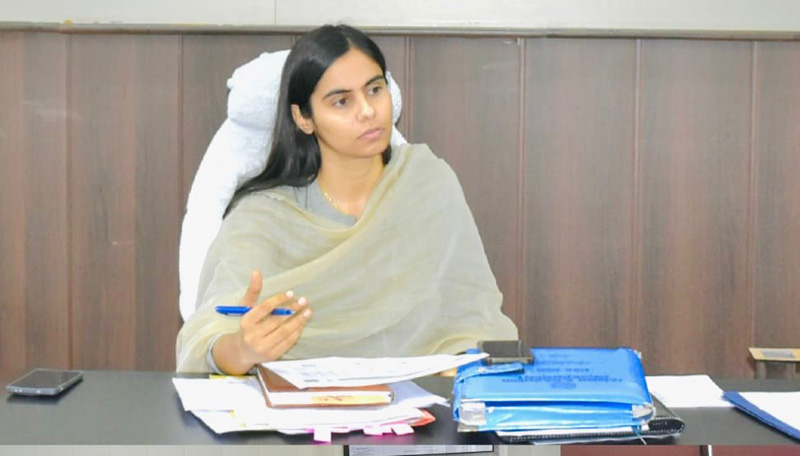







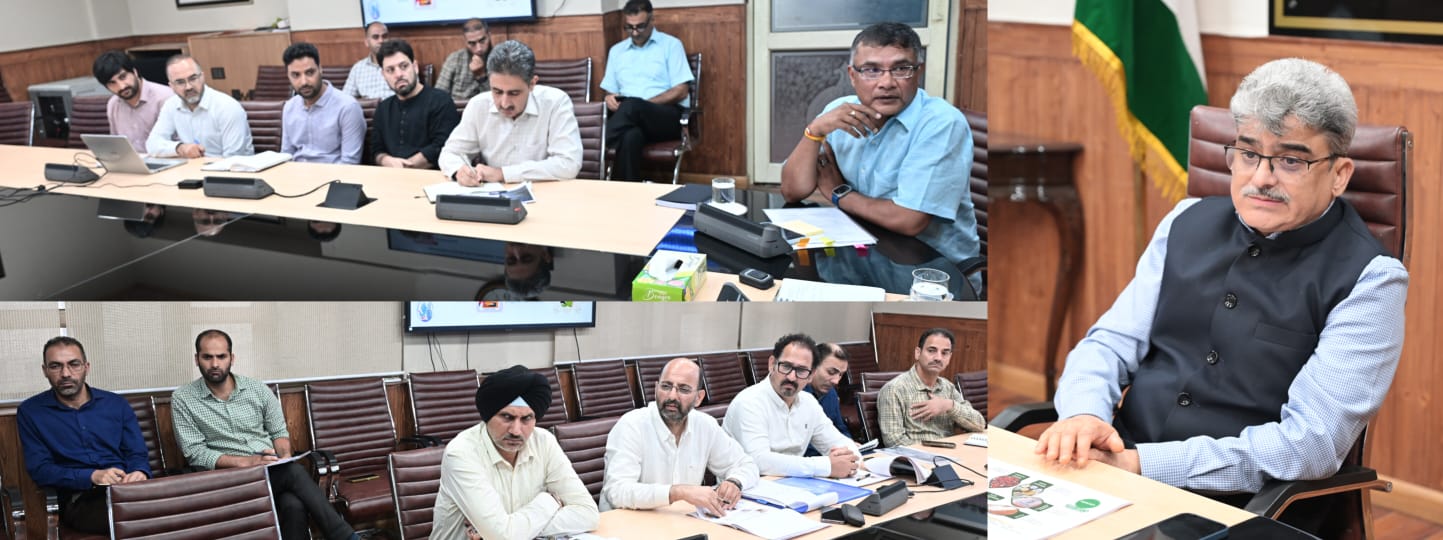
SRINAGAR: In a major move to protect Jammu & Kashmir’s rich cultural heritage and boost the livelihoods of its artisans and farmers, Chief Secretary Atal Dulloo today directed the Industries & Commerce Department to devise focused strategies to fully capitalize on the UT’s Geographical Indication (GI) tagged products.
Chairing a meeting aimed at unlocking the economic and cultural potential of GI products, the Chief Secretary stressed the need for robust measures to ensure their quality, authenticity, and global recognition.
The meeting was attended by Principal Secretary, Agriculture Production Department (APD); Commissioner Secretary, Industries & Commerce; Secretary, Industries Department; Director, Handloom & Handicrafts, Kashmir/Jammu; and other senior officials.
Highlighting the importance of traceability, the Chief Secretary urged steps to safeguard GI-tagged handicrafts against counterfeiting. He called for the expansion of testing facilities across J&K and for the expedited NABL accreditation of the Pashmina Testing and Quality Certification Centre (PTQCC) in Kashmir to enhance its acceptance in international markets.
Principal Secretary, APD Shailendra Kumar, proposed adopting tamper-proof labels for each product, detailing its unique features, place of origin, and creator. He suggested a quality enforcement mechanism, modeled on successful European systems, where substandard products could be returned to sellers with penalties. He also recommended raising visitor awareness about J&K’s crafts through billboards and informative material at craft villages.
Commissioner Secretary, Industries & Commerce Vikramjit Singh, highlighted that extensive GI-tagging of traditional crafts is underway to protect local craftsmanship, empower artisans, and improve market access for authentic products.
Director, Handicrafts & Handloom, Kashmir Masarat-ul-Islam, noted that GI certification preserves traditional skills while preventing counterfeiting. Each GI-tagged craft now carries a QR code providing details of the manufacturer, artisan, and material specifications, ensuring transparency and quality assurance.
Updates shared in the meeting included that the IICT Srinagar laboratory is NABL-certified, PTQCC has been upgraded with an Optical Fibre Diameter Analyzer (OFDA) to enhance testing capacity, and a proposal is underway for a new Quality Control Lab for eight newly registered GI crafts.
The Indian Institute of Carpet Technology has trained over 11,000 artisans, digitized numerous carpet and Kani designs, and established a Common Facility Centre for Yarn Dyeing.
As of March 2025, 15 crafts from Kashmir Division have received GI tags, including Sozni, Carpet, Pashmina Shawl, Kani Shawl, Papier Machie, Walnut Wood Carving, Khatamband, Crewel, Shikara, Namda, Tweed, Wagguv, Gabba, Chain Stitch, and Willow Bat. From Jammu Division, Basohli Pashmina, Rajouri Chikri Wood, and Basohli Painting hold GI status.
In agriculture, seven products—Kashmir Saffron, Basmati Rice, Mushk Budji Rice, Bhaderwah Rajmash, Ramban Sulai Honey, Udhampur Kaladi, and Ramban Anardana—have GI recognition, while others like Kashmir Ambri Apple, Kashmiri Haak, and Kashmiri Long Chilli are in the pipeline, with Pheran and Kangri slated for future registration.
This initiative underscores Jammu & Kashmir’s commitment to preserving centuries-old traditions, enhancing product credibility, and creating sustainable livelihood opportunities for its people.