






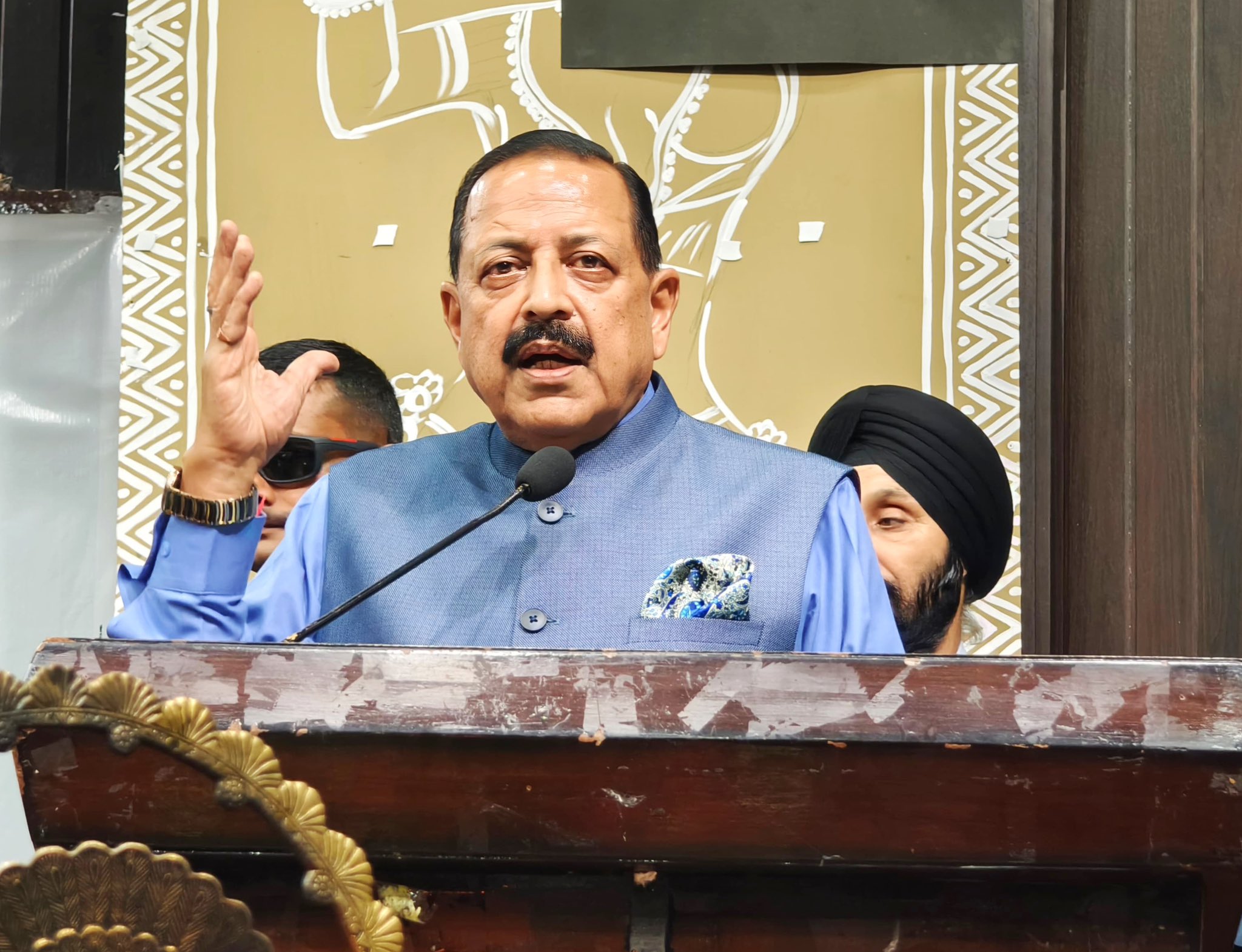
Jammu: Emphasizing the importance of viewing the Dogri language as a heritage asset rather than a burden, Union Minister Jitendra Singh said on Tuesday that mere imposition or preaching would not advance its promotion, noting that Dogri sees very little written communication.
“Dogri should be seen as a legacy asset to embrace contemporary trends rather than as a liability. There is also a need to link it with livelihood opportunities,” Singh said while delivering the sixth Kunwar Viyogi Memorial Lecture at the University of Jammu.
Highlighting the role of modern media and educational curricula in promoting the language, he urged institutions like Jammu University to take a proactive role. Singh further emphasized the importance of aligning the Dogra legacy with India’s global progress. “India is now adopting global strategies similar to those of other developed nations and is meeting international benchmarks. If the Dogra region and its people also integrate with this global journey, it will ensure the long-term sustainability of Dogra culture and pride,” he said.
Addressing students, the Union minister referenced the National Education Policy (NEP) 2020. “Earlier, many students were bound by their parents’ choices when selecting subjects. Now, they have the freedom to choose and combine subjects based on their aptitude,” he said, calling NEP 2020 a “game-changer.”
Singh encouraged students to leverage mobile technology and consider joining agri-startups after graduation, describing them as sources of sustainable livelihoods. He noted that over 4,000 youth had left traditional jobs to join the Purple Revolution, which propelled Bhaderwah in Doda district onto the global startup map, urging Dogra youth to explore such opportunities beyond government employment.
The minister also highlighted Jammu and Kashmir’s rich bio-resources, including lavender, and advocated for promoting Khadi products, noting that the government provides nearly 40% subsidy on loans to encourage production and sales.
Singh further spoke about the PM Vishwakarma Yojana, describing it as a scheme that not only provides livelihoods but also preserves traditional crafts by offering end-to-end support to artisans and craftspersons.