






New Delhi [India]: Union Minister of State (Independent Charge) for Science & Technology, and Minister of State for PMO, Personnel, Public Grievances, Pensions, Atomic Energy and Space, Jitendra Singh, announced that on August 5–6, 2025, two Indian aquanauts successfully completed deep-sea dives to depths of 4,025 meters and 5,002 meters in the Atlantic Ocean—marking a historic first for India, according to the Ministry of Earth Sciences.
The Indian aquanauts, Senior Scientist Raju Ramesh and Cdr. Jatinder Pal Singh (Retd), conducted the dives over a total duration of about seven hours, gaining valuable experience and making critical observations before safely returning to the surface.
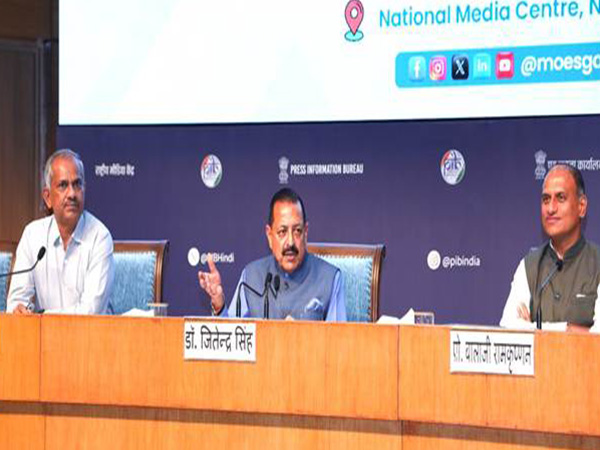
Addressing the media, Jitendra Singh noted that India now joins an elite group of fewer than six nations to have reached such ocean depths. The expedition was carried out in collaboration with IFREMER, the French marine research institute, aboard its submersible Nautile. This milestone sets the stage for India’s Samudrayan Mission, which aims to send three aquanauts to 6,000 meters in the indigenously developed submersible MATSYA-6000 by 2027.
Part of the Government of India’s flagship Deep Ocean Mission, Samudrayan seeks to explore and sustainably utilize deep-sea resources. Singh expressed personal pride in Cdr. Jatinder Pal Singh, a native of Jammu, calling it “a personal moment of pride for India.”
Singh also highlighted that this achievement comes just four weeks after Indian astronaut Shubhanshu Shukla’s successful return from the International Space Station on the AXIOM-4 mission. “With Indians now having achieved maiden voyages both in space and the deep ocean, we have demonstrated our scientific ambition, prowess, and mettle—moving closer to the vision of a Viksit Bharat as envisaged by Prime Minister Narendra Modi,” he said.
Recalling the Prime Minister’s support, Singh noted that the mission was highlighted in Independence Day addresses in 2021 and 2023, emphasizing that oceans and space will be twin pillars of India’s future economic growth. “India is no longer a follower but a leader, inviting global collaboration on futuristic missions,” he added.
India, with its 11,098 km coastline and vast Exclusive Economic Zone (EEZ), holds immense potential for both living and non-living marine resources. Singh called for focused efforts to tap these resources and strengthen the blue economy, noting India’s contract with the International Seabed Authority to explore deep-sea minerals at 4,000–5,500 meters.
The aquanauts belong to the National Institute of Ocean Technology (NIOT), Chennai, which is developing MATSYA-6000. With this submersible, India will become the sixth nation to build its own deep-ocean human submersible. MATSYA-6000, a fourth-generation scientific submersible, is designed for 12 hours of operational endurance and up to 96 hours in emergencies. It features advanced systems including a high-density Li-Po battery, underwater acoustic telephone, emergency escape mechanisms, and crew health monitoring.
Following successful wet trials at L&T Shipyard, Kattupalli, Tamil Nadu, in early 2025, MATSYA-6000 is expected to conduct 500-meter shallow-water trials by 2026.
A five-member NIOT team, led by Dr. Ramesh Sethuraman, boarded IFREMER’s research vessel L’Atalante off Lisbon, Portugal, on August 3, 2025. Secretary of the Ministry of Earth Sciences, M. Ravichandran, highlighted that the team gained extensive hands-on experience in pre-dive preparation, piloting, buoyancy management, manipulator operations, sample collection, dive planning, and other critical procedures.
These learnings will directly support MATSYA-6000’s development and the broader objectives of the Deep Ocean Mission, which include deep-sea mining, human submersible advancement, and ocean climate advisory services.
Previously, Indian scientists had dived to 3,800 meters and 2,800 meters in 1997 and 2002 using the submersibles Alvin (USA) and Nautile (France). This expedition sets a new record in India’s deep-sea capabilities.
The media briefing was attended by Prof. Balaji Ramakrishnan, Director, NIOT; Dr. M.V. Ramana Murthy, Mission Director, Deep Ocean Mission; and other senior scientists from NIOT and the Ministry of Earth Sciences.