






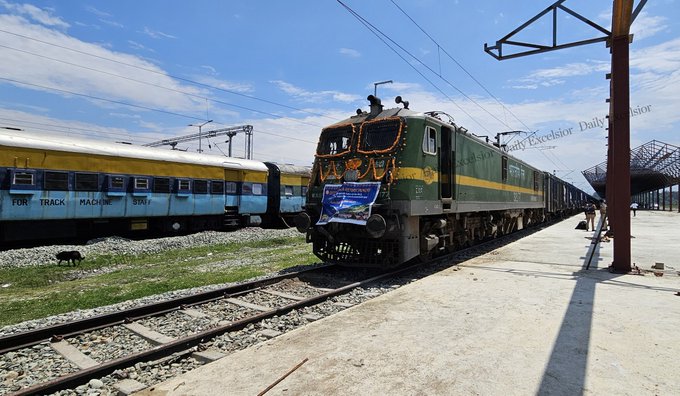
Srinagar: Marking a historic milestone for Kashmir’s transportation network, Northern Railways has welcomed the arrival of the first loaded freight train at Anantnag Railway Station.
This significant event inaugurates the operational launch of the newly commissioned Banihal-Sangaldan-Reasi-Katra section of the Udhampur-Srinagar-Baramulla Rail Link (USBRL) project.
With this advancement, Kashmir’s rail network is now fully integrated into the Indian Railways freight corridor, allowing direct movement of goods from across India into the Valley.
This development is expected to stimulate economic growth by opening new trade opportunities, lowering transportation costs for businesses and essential goods, ensuring year-round delivery despite challenging weather, and enhancing regional connectivity within the national railway system.
The 272 km-long USBRL project has recently been commissioned, covering the districts of Udhampur, Reasi, Ramban, Srinagar, Anantnag, Pulwama, Budgam, and Baramulla in Jammu and Kashmir.
The USBRL is one of the most challenging new railway projects undertaken in India since independence. Traversing the young Himalayas, the route faces numerous geological challenges. Among its engineering feats are the world’s highest railway bridge over the Chenab River in Reasi district—measuring 1,315 meters in length with a 467-meter arch span and standing 359 meters above the riverbed—and Indian Railways’ first cable-stayed bridge over Anji Khad, featuring a deck 331 meters above the riverbed and a main pylon height of 193 meters.
The project has also significantly contributed to the region’s socio-economic development, generating over 5 crore man-days of employment. Additionally, it includes the construction of more than 215 km of approach roads, featuring tunnels and 320 small bridges, which have greatly improved local connectivity and boosted socio-economic conditions.
Meeting international safety standards, the USBRL project is equipped with mechanical ventilation in all tunnels longer than 2 km to maintain air quality. Firefighting systems, including hydrants and extinguishers, are installed to address potential fire hazards promptly. For passenger safety, escape tunnels totaling 66 km have been constructed in sections where tunnels exceed 3 km in length.