







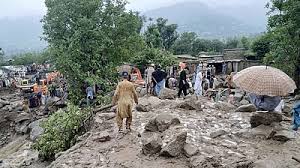
Peshawar: The death toll from recent flash floods in Pakistan’s Khyber Pakhtunkhwa has risen above 300, including 13 children, provincial authorities reported on Saturday.
Heavy rains, which triggered flash floods across several districts, are expected to continue intermittently until August 21, according to the Provincial Disaster Management Authority (PDMA).
PDMA spokesman Faizi stated that over the past 48 hours, 307 people lost their lives due to intense rainfall, cloudbursts, and flash floods. A preliminary report indicates the victims include 279 men, 15 women, and 13 children. Additionally, 23 people sustained injuries, comprising 17 men, four women, and two children.
The hardest-hit districts are Buner, Shangla, Mansehra, Swat, Bajaur, Battagram, and Torghar, with Buner reporting the highest fatalities at 184. Shangla recorded 36 deaths, Mansehra 23, Swat 22, Bajaur 21, Battagram 15, Lower Dir five, and one child drowned in Abbottabad.
The PDMA said 74 houses have been damaged so far, with 63 partially and 11 completely destroyed. Relief teams and district administrations are coordinating closely and continuously monitoring the situation.
Relief funds have been disbursed for the affected districts under directives from Khyber Pakhtunkhwa Chief Minister Ali Amin Gandapur, who instructed all relevant departments to accelerate rescue and relief efforts. Measures have also been ordered to mobilize resources for clearing blocked highways and link roads in tourist areas. Tourists have been advised to stay updated on weather conditions and take necessary precautions.
The PDMA spokesperson had warned on Friday that casualties could rise further as many people remain missing. Since late June, the onset of the monsoon season has caused widespread devastation across Pakistan, especially in Khyber Pakhtunkhwa and northern regions, with deadly floods, landslides, and displacement affecting vulnerable, densely populated, and poorly drained areas.