







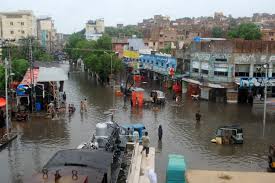
LAHORE: At least 17 people have died in the past 24 hours as floods submerged hundreds of villages across Punjab, Pakistan, officials said on Thursday.
Heavy flooding in the Sutlej, Ravi, and Chenab rivers has forced mass evacuations, damaged infrastructure, and inundated millions of acres of farmland in the province, home to over 130 million people.
According to Punjab Emergency Services Rescue 1122, 17 deaths were reported in the last 24 hours: seven in Sialkot, four in Gujrat, three in Narowal, two in Hafizabad, and one in Gujranwala. Officials attributed the unusually high water levels to heavy rainfall and the release of excess water from Indian dams.
Federal Minister for Development Ahsan Iqbal accused India of “water aggression,” stating, “India should have treated this as a natural calamity and cooperated with Pakistan. Instead, it released water in the form of a flood wave, using it as a weapon.”
India has opened all gates of the Thein Dam on the Ravi River, prompting the Punjab administration to deploy the Pakistan Army in eight districts—Lahore, Okara, Faisalabad, Sialkot, Narowal, Kasur, Sargodha, and Hafizabad—to assist in rescue and relief operations. Pakistan has also been warned about potential releases from the rapidly filling Madhopur Dam, both of which are on the Ravi River flowing from India into Pakistan.
On Sunday, India issued flood warnings to Pakistan through diplomatic channels on “humanitarian grounds.” This followed a series of punitive measures taken by India after the Pahalgam terror attack on April 22, including putting the 1960 Indus Waters Treaty in “abeyance,” which normally governs flood alert communications through the Indus Water Commission.
The Provincial Disaster Management Authority (PDMA) reported major flood surges moving downstream, with exceptionally high water levels at Khanki and Qadirabad headworks on the Chenab and at Ganda Singh Wala on the Sutlej. The Ravi at Jassar and Shahdara also remains in high flood, prompting evacuations in parts of Lahore.
So far, over 250,000 people have been evacuated, with relief operations ongoing. Prime Minister Shehbaz Sharif and Punjab Chief Minister Maryam Nawaz conducted an aerial survey of affected areas on Thursday. The provincial government estimates around one million people have been impacted.
PDMA reported that 340 villages along the Chenab River in Sialkot, Wazirabad, Gujrat, Mandi Bahauddin, Chiniot, and Jhang are severely affected. Similarly, 335 villages along the Sutlej River, including Kasur, Okara, Pakpattan, Multan, Vehari, Bahawalnagar, and Bahawalpur, are under floodwater. Several highways, particularly in Narowal, Shakargarh, and Sialkot, are completely submerged.
Director General Irfan Ali Kathia said a major flood surge is moving through the river system, with key infrastructure currently secure and large-scale evacuations underway in vulnerable areas.
Meanwhile, floodwaters have submerged the entire Kartarpur Corridor complex, including Gurdwara Darbar Sahib, raising concerns over potential damage to the structure, the Sikh holy book, and relics. Around 150 officials and pilgrims stranded there were rescued on Wednesday.
The Kartarpur Corridor, opened in November 2019, spans 4.1 km from the Pakistan-India border and links Pakistan’s Gurdwara Darbar Sahib, where Guru Nanak Dev lived, to Dera Baba Nanak in India’s Gurdaspur district, allowing visa-free access for Indian pilgrims.