






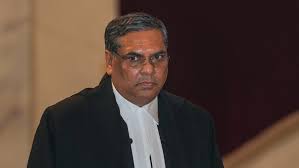
New Delhi: Former Chief Justice of India Sanjeev Khanna has told a parliamentary committee examining the simultaneous elections bill that establishing the constitutional validity of a proposal does not automatically determine its desirability or necessity.
In a written submission to the committee, Khanna noted that concerns about weakening the federal structure could be raised against the constitutional amendment bill, even as he outlined the main arguments for and against the proposal, sources said.
Most experts who have appeared before the panel, chaired by BJP MP P. P. Chaudhary, have rejected claims that the bill is unconstitutional but have flagged issues with its provisions. Khanna, who will interact with the committee on Tuesday, has joined some other former CJIs in questioning the extent of powers granted to the Election Commission (EC) under the bill.
According to him, the bill gives the EC “unfettered discretion” to decide if an assembly election cannot be held along with the Lok Sabha polls and to recommend the same to the President. “This clause could be challenged as violating the basic structure of the Constitution, being arbitrary and contrary to Article 14,” he is learnt to have said.
Khanna cautioned that postponing elections on the EC’s recommendation could effectively impose indirect President’s Rule, meaning the Union government would run a state, which could face judicial scrutiny for undermining federalism. He also argued that simultaneous elections held in 1951-52, 1957, 1962 and 1967 were only a matter of circumstance, not a constitutional mandate.
Clarifying the scope of judicial review, Khanna said that when the Supreme Court or high courts uphold the constitutional validity of a law, it is only an affirmation that it does not breach constitutional limits. “Such rulings do not amount to a pronouncement on the desirability or necessity of the provisions,” he said.
Before Khanna, former CJIs D. Y. Chandrachud, J. S. Khehar, U. U. Lalit and Ranjan Gogoi also appeared before the committee to share their views on the “one nation, one election” proposal.
While the BJP and its allies argue the bill will save costs, reduce frequent deployment of officials on election duty, and boost growth by avoiding repeated imposition of the Model Code of Conduct, the Opposition contends it threatens democratic principles and weakens the federal structure.