






Jammu: Government Races to Restore Water Supply After Catastrophic Floods
The Jammu and Kashmir government mobilized all available resources, including skilled labor from neighboring states, to restore water supply following the worst crisis in recent memory, officials said.
The catastrophic floods, triggered by the heaviest rainfall in nearly a century, caused unprecedented damage to the city’s water infrastructure. The Tawi River surged to 34 feet, surpassing the devastating 33 feet recorded in 2014.
The Tawi Water Treatment Plant suffered severe damage, and massive landslides along the Panjtirthi–Sidhra road destroyed over 500 meters of the Sitlee–Lohar and Sitlee–Manda transmission pipelines, disrupting water supply to Old City, Janipur, Rehari Colony, New Plot, Subhash Nagar, Sarwal, Chinore, and Roop Nagar.
A critical rising main connecting five tubewells along the Tawi’s left bank—feeding the Boria Water Filtration Plant—was heavily damaged, along with the pump room, high-tension lines, poles, transformer, and control panels. Large debris and silt accumulated at the Boria Intake and Dhounthly Water Treatment Plants, while the surrounding hilly terrain slid toward the river, leaving massive debris blocks.
The 500 mm rising main was washed away along with concrete blocks, and the 600 mm main suffered significant damage, with some portions left hanging. The Sitlee–Lohar 500 mm main was completely washed away over a span of around 30 meters.
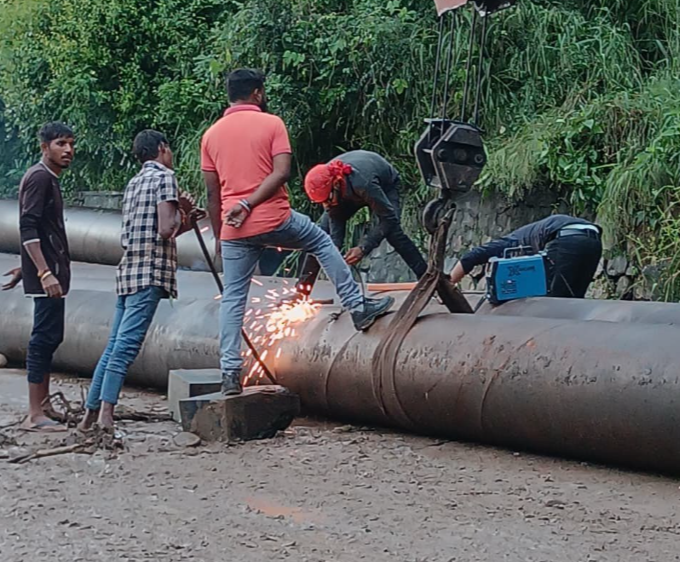
Once the approach road was cleared, repair crews were immediately deployed. As restoring pipelines along the original alignment was not feasible, both rising mains were realigned using 600 mm MS casing pipes available with the department.
Given that Jammu’s water supply depends entirely on lift schemes, the Jal Shakti Department acted promptly, deploying technical staff citywide. Damage at Sitlee, Lohar, Manda, Boria, and Dhounthly was carefully assessed, and materials, equipment, cranes, generators, welding sets, and trained personnel were arranged.
Despite ongoing heavy rainfall, restoration began within 24 hours. Skilled laborers mobilized by the Jammu Municipal Corporation (JMC) worked tirelessly in sliding zones to re-lay the 600 mm and 500 mm mains across the hilly terrain. Even though pipelines had been damaged during the floods of August 25–26, further damage occurred on August 29–30 due to continued rains. Nevertheless, water supply through Sitlee, Lohar, and Dhounthly was partially restored within a week.
With power supply restored, 70% of urban tubewells were operational within 48 hours and the remainder within 72 hours, meeting nearly half of the city’s potable water demand. Irrigation pumps from the Ravi Tawi system were deployed to maintain raw water supply to the Boria Filtration Plant. Between August 30 and September 6, overall water supply improved from 39 MGD to 50 MGD, approaching the pre-flood level of 62 MGD.
Urban water supply management was transferred to the JMC in February 2021 under the 74th Constitutional Amendment, with the Jal Shakti Department providing technical support through deputed staff. While the Jal Shakti Department focused on production, the JMC managed distribution and maintained tanker services until full restoration.
To meet emergency needs, the Deputy Commissioner of Jammu added 90 tankers and, under Section 163 of the Bharatiya Nagarik Suraksha Sanhita (BNSS), regulated private tankers and borewell operations. This facilitated nearly 5,000 tanker trips in six days to hospitals, old-age homes, police stations, community centers, and affected residential areas—all free of charge, officials said.