






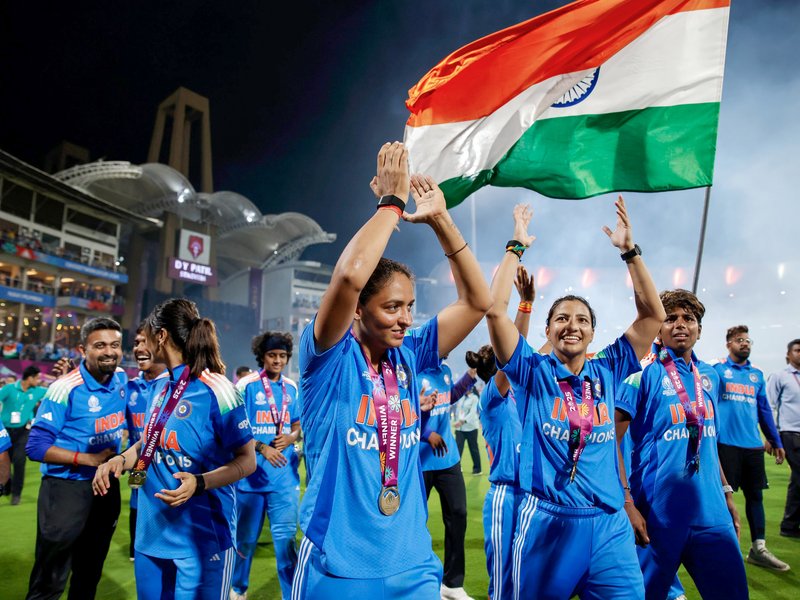
New Delhi: History was scripted on November 2 as a roaring crowd of nearly 40,000 at DY Patil Stadium in Navi Mumbai witnessed India lift their maiden Women’s ODI World Cup trophy with a 52-run victory over South Africa.
Led by Harmanpreet Kaur, the Indian team — a mix of players from big cities and small towns — united to carve a new chapter in Indian women’s cricket. Former India cricketer and ex-chief selector Hemlata Kala believes this moment will resonate far beyond the boundary, much like the men’s iconic 1983 triumph.
In a candid conversation with IANS, Hemlata draws parallels between the two historic wins and explains why this victory could redefine the future of women’s cricket in India.
Q. What does this World Cup win mean to you?
A. It means everything. We’ve been chasing this dream since 2005 — we reached finals but couldn’t cross the line. This time, Harman’s team made it happen. It reminds me of the 1983 men’s win; a turning point that changed Indian cricket forever. This victory can do the same for women’s cricket — it will inspire countless girls to take up the game and believe that they can make a future in it.
I was deeply emotional — we had waited so long for this. When Laura’s wicket fell, I knew we would win. Deepti’s spell was brilliant; she removed the key player, and that sealed it for us.
Q. The team bounced back after three straight league losses. How do you see that turnaround?
A. Many had written us off. But I was confident — especially about a possible clash with New Zealand. Their record in India isn’t great, and I knew if we reached the knockouts, we could beat anyone. The semi-final against Australia was crucial, but the team showed great spirit and resilience throughout.
Q. Shafali Verma wasn’t in the main squad earlier, yet she played a match-winning role in the final. Your thoughts?
A. Honestly, she should’ve been in the squad from the start. Her comeback in the final was remarkable — those two wickets she took changed the game completely. Her 87 runs were vital too; on a slow wicket, she batted maturely and sensibly.
Shafali has grown immensely — her fielding has improved, and she used her bowling smartly, varying her pace with intelligence. Her performance in the final proved her value beyond doubt.
Q. How has Shafali evolved as a batter?
A. Tremendously. I’ve seen her play domestic cricket — she dominated matches for Haryana almost single-handedly. She’s matured, reading situations better and staying composed under pressure. Playing domestic games when she was out of the national side helped her grow in all three departments — batting, bowling, and fielding.
Q. Deepti Sharma’s consistency has been exceptional. How do you see her evolution?
A. I’ve known Deepti since she was 8 or 9. Her growth has been phenomenal — she delivers in every series, with either bat or ball. Her improvement in bowling, especially in variations and accuracy, is commendable. She’s put in years of hard work, and now it’s clearly paying off.
Q. What can young players learn from Deepti’s journey?
A. Hard work and dedication always pay. Coming from Agra, Deepti had to fight for everything — she sacrificed family time, comfort, everything for cricket. Her focus and discipline are what every young player should emulate.
Q. How can stakeholders build on this momentum for women’s cricket?
A. The BCCI deserves huge credit. Since 2017, their support has grown massively — from introducing WPL to providing central contracts and training camps. Back in the day, we had only one series a year, sometimes none for 2–3 years. Now, the structure is far stronger, and domestic players get more exposure.
Like 1983 changed men’s cricket, 2025 can revolutionize women’s cricket. With the BCCI and state associations investing seriously, we’ll see more girls from every corner of India take up the sport.
Q. What societal impact do you foresee after this win?
A. Huge. Over 20 crore people watched the final live — the celebrations across the country were unbelievable. Even in smaller cities like Agra, people burst crackers in joy. After 2017 and WPL, parents have already started encouraging girls to play cricket. This win will only amplify that enthusiasm.
Q. What was your most memorable moment from the final?
A. The trophy lift — without a doubt. It was emotional because we had dreamt of it for so long. As Jemimah Rodrigues said, this win belongs to everyone who paved the path — from Mithali Raj, Jhulan Goswami, Anjum Chopra, Diana Edulji, and Shanta Rangaswamy to all women who played when people said cricket wasn’t for women. This victory is their legacy, too.
Q. How do you see the future of this Indian team?
A. The sky’s the limit. The T20 World Cup in England is next — and yes, they can win that too. The BCCI is doing tremendous work across all levels — U15, U19, zonal camps, Challenger Trophies — and the results are showing.
There was a time when Indian teams struggled abroad; now, they fight and win in all formats. If this progress continues, I believe we’ll soon be talking about multiple world titles in women’s cricket. The future truly belongs to India.