






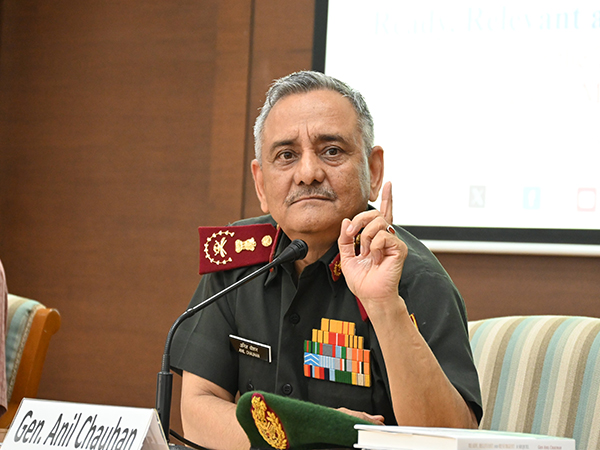
New Delhi: Chief of Defence Staff (CDS) General Anil Chauhan on Friday delivered an engaging talk on his book Ready, Relevant and Resurgent: A Blueprint for Transformation of India’s Military at the Vivekananda International Foundation, New Delhi.
During his address, General Chauhan shared that the book’s title originated at the Combined Commanders Conference 2023—an event chaired by the Prime Minister of India and held biennially.
“The title Ready, Relevant and Resurgent was something we framed for ourselves during the 2023 Combined Commanders Conference. That was the theme we had chosen for the conference,” he recalled.
The CDS revealed that a sequel to the book is already underway. He emphasised that India’s military transformation is not merely structural, but also a deep cultural and cognitive shift—anchored in both Shastra (knowledge) and Shashtra (weapons).
“I’m ready with another book that will expand on our transformation plans. In the Indian system, Shastra and Shashtra must go hand in hand—knowledge of weapons, strategy, tactics, and statecraft. We cannot rely on just a few exceptional generals like in the past; we need a system that consistently produces such leaders,” he said.
The talk outlined significant reforms driving India’s military modernisation—centred on jointness, future-readiness, and strategic agility. Key initiatives mentioned in the book include:
- Integration of the tri-Service Staff College to foster joint operations.
- Accelerated doctrine development—completed four times faster through distributed authorship.
- Online training and evaluation linked to career progression.
- Rank-agnostic courses on future warfare open to the armed forces, academia, and industry.
- Civilian faculty involvement to strengthen academic rigour in military education.
- A unified e-library system to share knowledge resources across services.
General Chauhan said his primary goal in writing the book was to raise awareness—particularly within the armed forces—about ongoing reforms.
On Thursday, the CDS and the Secretary, Department of Military Affairs, also released the declassified versions of the Joint Doctrine for Cyberspace Operations and the Joint Doctrine for Amphibious Operations at the Chiefs of Staff Committee meeting in New Delhi.
The Joint Doctrine for Cyberspace Operations provides a unified framework to safeguard India’s cyberspace interests, integrating offensive and defensive capabilities. It focuses on threat-informed planning, resilience, real-time intelligence, and the development of joint cyber capabilities.
The Joint Doctrine for Amphibious Operations—covering missions over both land and sea—sets guidelines for integrating maritime, air, and land forces. It highlights interoperability, rapid response, and joint application of force to achieve operational impact ashore.
The Defence Ministry noted that the CDS has also initiated work on new doctrines for emerging and niche domains, including Military Space Operations, Special Forces Operations, Airborne/Heliborne Operations, Integrated Logistics, and Multi-Domain Operations. These doctrines aim to create a common lexicon for stakeholders and ensure smooth, coordinated execution of joint missions.
If you want, I can also prepare a more concise, news-agency-style version of this for sharper readability and faster impact. That would cut it to around 300–400 words while retaining the core facts. Would you like me to do that next?