






ISRO to Launch 6,500 kg US Communication Satellite
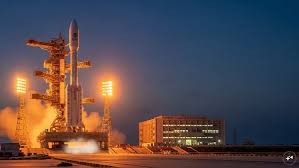
Chennai: After beginning its journey in 1963 with a tiny US-supplied rocket, the Indian Space Research Organisation (ISRO) is set to launch a 6,500 kg American-built communication satellite from Indian soil in the coming months, ISRO Chairman and Department of Space Secretary V. Narayanan announced on Sunday.
Speaking at the 21st Convocation of SRM Institute of Science and Technology near Chennai, where he was awarded an honorary Doctor of Science degree by Maharashtra Governor C.P. Radhakrishnan, Narayanan highlighted ISRO’s transformation from humble beginnings to a global space leader.
Recalling key milestones, he noted that in 1975, ISRO demonstrated “mass communication” using US-provided satellite data by installing 2,400 televisions in villages across six states. More recently, on July 30, ISRO launched the costliest satellite ever built — the NASA-ISRO Synthetic Aperture Radar (NISAR) — aboard a GSLV-F16, carrying both US and Indian payloads. NASA, he said, praised the precision of the launch.
“In another couple of months, the country that once received a small rocket from the US will launch a 6,500 kg US-built communication satellite using our own launcher,” Narayanan said, calling it a testament to ISRO’s remarkable growth.
ISRO has so far launched 433 satellites for 34 countries. Its applications today span 55 areas, including broadcasting, telecom, weather forecasting, disaster warning, navigation, and food and water security. Narayanan also cited landmark missions like Chandrayaan-1, which discovered water molecules on the Moon, and Chandrayaan-3, which achieved the first soft landing on the Moon’s south pole.
Highlighting ISRO’s record-breaking feat in 2017, he said, “We broke Russia’s record of 34 satellites by launching 104 satellites, including India’s Cartosat-2 Series, in a single mission aboard PSLV-C37.”
Looking ahead, ISRO plans to triple its current fleet of 56 satellites within three years, launch the Gaganyaan human spaceflight mission, and establish an Indian space station by 2035. By 2040, Narayanan projected, India’s space capabilities would match those of developed nations.
Governor Radhakrishnan, addressing the graduates, stressed that sincerity, hard work, and patience are keys to success, urging them to embrace lifelong learning and humility.
During the convocation, Ministry of Earth Sciences Secretary M. Ravichandran also received an honorary Doctor of Science degree. In total, 9,769 students — including 2,183 women — graduated, with 157 top rankers honoured.