






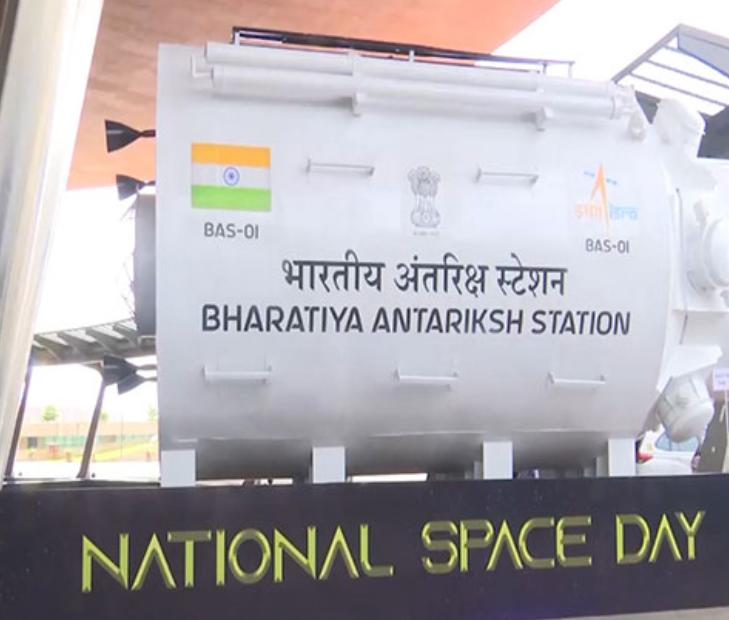
New Delhi: On the occasion of National Space Day, the Indian Space Research Organisation (ISRO) on Saturday unveiled the model of the Bharatiya Antariksh Station (BAS) in Delhi.
ISRO plans to launch the first module of the orbital station by 2028, with the full facility expected to be operational by 2035. The BAS will serve as a hub for indigenous research, enabling microgravity experiments and advancing technologies essential for long-duration human space missions.
Highlighting India’s ambitious roadmap, ISRO Chairman V. Narayanan said the country will establish its space station by 2035 and undertake a crewed lunar landing by 2040. He also announced upcoming missions, including Chandrayaan-4 and a Venus Orbiter Mission, adding that the Prime Minister has already approved the development of a Next Generation Launcher (NGL) to support these initiatives.
“By 2035, we will have the Bharatiya Antariksh Station, with the first module lifted off by 2028. By 2040, India will land on the Moon and return safely. This will place the Indian space program at par with the world’s leading space powers,” Narayanan said.
Earlier, Prime Minister Narendra Modi virtually addressed the event, recalling the historic achievement of Chandrayaan-3, which made India the first country to successfully land near the Moon’s south pole. He praised India’s scientists for consistently setting new benchmarks in space exploration.
“Achieving milestone after milestone has become the nature of India and its scientists. Just two years ago, India created history by reaching the Moon’s South Pole,” PM Modi noted.
The Prime Minister also lauded the success of Axiom Mission-4, where Group Captain Shubhanshu Shukla hoisted the tricolour aboard the International Space Station (ISS). Recalling his recent meeting with Shukla, Modi said he witnessed the “immense courage and infinite dreams” of India’s youth.
“With this mission, India has also become the fourth country capable of docking and undocking in space. The pride I felt when Group Captain Shukla showed me the tricolour at the ISS is beyond words,” he said.