






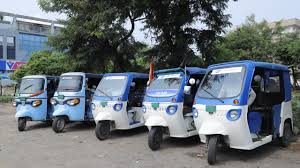
Jammu: The zonal regulation system for electric three-wheelers — including e-rickshaws, autos, and carts — came into force in Jammu district on Thursday, sparking widespread discontent among operators and commuters, who termed the move “impractical” and “anti-people.”
Traffic Police Jammu, in a public notice, announced that the operation of these vehicles would now be governed by a colour-coded zonal scheme.
“Each vehicle must operate strictly within its designated zone and display colour-coded identification plates along with matching strips on the front and rear,” the notice stated.
Senior Superintendent of Police (Traffic) Jammu, Farooq Qaiser, said inter-zonal movement of vehicles would not be permitted under any circumstances. “Any vehicle found plying without proper colour coding will be seized and penalised. Moreover, e-rickshaws and autos are barred from operating on flyovers, national highways, and state highways within the district to ensure smooth traffic flow and public safety,” he added.
Under the new framework, seven crossings on highways have been designated to facilitate safe and controlled movement between operational areas. Additionally, e-three-wheelers registered outside Jammu district are prohibited from operating within city limits, with strict enforcement action promised against violators.
The move, however, has drawn strong backlash from both operators and passengers. Many called the decision “unjustified” and “highly inconvenient.”
“This rule makes no sense. A passenger travelling from Jewel Chowk to the Railway Station — barely three kilometres — will now have to switch autos midway,” said Sohan Lal, an e-rickshaw driver from north Jammu.
Another operator, Sukhwant Singh from Gandhi Nagar, highlighted the rule’s impact on emergency travel. “If a patient has to be taken from Nanak Nagar to GMC Hospital, I can’t go beyond the Tawi bridge. The patient will have to change autos midway — it’s absurd.”
Commuters echoed similar frustrations, warning that the decision could worsen inconvenience and confusion. “Instead of easing mobility, this will create chaos. The authorities must reconsider,” said Omkar Nath of Janipur.
Many residents, however, acknowledged that the city’s e-three-wheeler numbers have ballooned — rising by an estimated 70,000 to 80,000 in just 18 months — adding to severe traffic congestion.
“Almost every second vehicle you see in the city is an auto. Regulation is needed, but it should be practical,” remarked Avtar Singh, a retired officer.
Jammu Deputy Commissioner Dr. Rakesh Minhas said the “rapid and significant increase” in battery-operated three-wheelers had led to traffic jams, unregulated movement, and overcharging.
“To address these challenges, extensive consultations were held with operators, and appropriate directions were issued. The primary aim is to ensure road safety, traffic discipline, and commuter convenience while safeguarding the genuine interests of operators,” he said.