






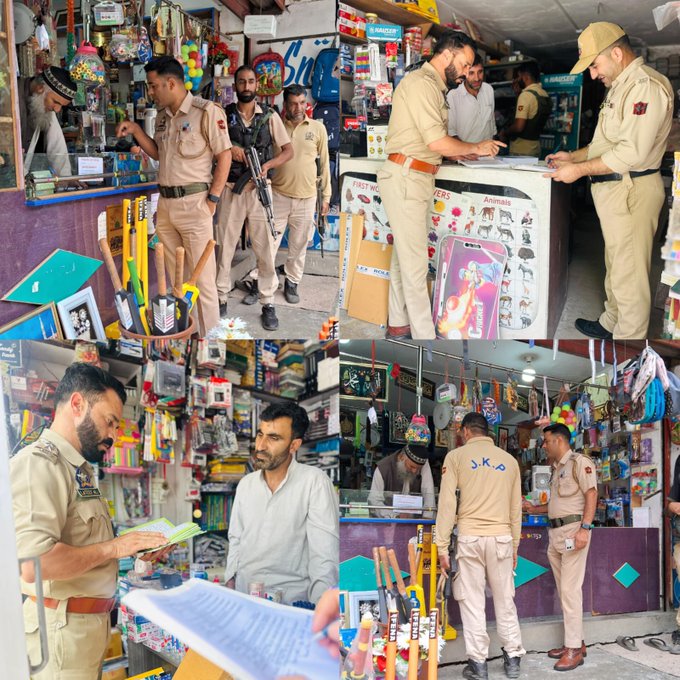
Srinagar: A day after the Jammu and Kashmir administration banned 25 books for allegedly “promoting false narratives and glorifying terrorism,” police on Thursday launched a series of raids on bookshops across the Valley to seize the publications and curb their circulation.
According to an order issued by the Home Department, the banned books — authored by prominent writers such as Moulana Moududi, Arundhati Roy, A.G. Noorani, Victoria Schofield, and David Devadas — are accused of propagating secessionist ideologies in Jammu and Kashmir. The government cited Section 98 of the Bharatiya Nagarik Suraksha Sanhita, 2023, as the legal basis for the forfeiture.
The ban has drawn criticism from authors and political leaders, who have described it as a crackdown on free speech. Critics argue that democracy thrives on the free exchange of ideas, and that banning books is a regressive step.
Police raids were conducted in the districts of Srinagar, Ganderbal, Anantnag, Kulgam, Pulwama, Shopian, and Baramulla, officials said. They confirmed that teams searched multiple bookshops for the prohibited titles in compliance with the government order.
“These enforcement drives were aimed at confiscating radical literature in accordance with official directives,” said a senior police official. “The operation targeted materials that glorify terrorism or promote separatist ideologies.”
Shop owners were warned against stocking or distributing the banned content and were informed of the legal repercussions of non-compliance. Authorities also appealed to the public to cooperate in maintaining peace and integrity, urging citizens to report any suspicious activity, including the circulation of proscribed literature.
The government order claimed that credible intelligence and investigative findings point to the dissemination of secessionist literature as a key factor behind youth radicalisation and recruitment into violence and terrorism. Often disguised as political or historical commentary, such publications are said to distort facts, glorify militants, demonise security forces, and incite religious and political alienation.
Welcoming the move, BJP leader and Jammu & Kashmir Wakf Board Chairperson Darakhshan Andrabi said terrorism in the region had not spread through weapons alone, but also through literature. “Some authors glorified terrorism. These books should have been banned long ago. Better late than never,” she said.
On the other hand, PDP president and former chief minister Mehbooba Mufti criticised the action, saying censorship only strengthens the power of ideas. “Democracy thrives on the free exchange of ideas. Banning books cannot erase history — it only deepens division,” she wrote on X (formerly Twitter). “Suppressing democratic voices and curbing freedoms leads to alienation and mistrust.”
The CPI(M) called the ban a “brazen attack on freedom of expression” and demanded its immediate revocation. “This censorship is yet another manifestation of authoritarianism,” the party said in a statement.
National Conference spokesperson Imran Nabi Dar said the Lieutenant Governor’s administration may be justified in banning literature that clearly glorifies violence, but expressed concern over the inclusion of well-researched, critical works. “If certain texts incite violence or promote terrorism, the government must offer clear justification. Otherwise, it raises serious questions,” he said.
Hurriyat Conference chairman Mirwaiz Umar Farooq also condemned the ban, stating on X that erasing books does not erase historical truths. “These actions only reflect the insecurities and limited understanding of those in power,” he wrote.
Among the banned books are:
- Al-Jihad fil Islam by Moulana Moududi
- Independent Kashmir by Christopher Snedden
- In Search of a Future: The Story of Kashmir by David Devadas
- Kashmir in Conflict: India, Pakistan and the Unending War by Victoria Schofield
- The Kashmir Dispute (1947–2012) by A.G. Noorani
- Azadi by Arundhati Roy
The government claimed the banned literature contributes to radicalisation by distorting history, glorifying violence, promoting alienation, vilifying security forces, and encouraging religious extremism.
Political scientist and author Sumantra Bose, two of whose books (Kashmir at the Crossroads: Inside a 21st-Century Conflict and Contested Lands) are among the banned titles, rejected the allegations. “Since 1993, my primary aim has been to identify peaceful resolutions to conflict, including in Kashmir,” he told PTI. “Any defamatory claims about my work are entirely unfounded.”
Another banned title is Kashmir: A Case for Freedom, co-authored by anthropologist Angana Chatterjee along with Tariq Ali, Hilal Bhat, Habbah Khatun, Pankaj Mishra, and Arundhati Roy. Reacting to the ban, Chatterjee said, “Authoritarian regimes ban books to assert power and intimidate dissenting voices. This is a warning to Kashmiris against free speech and seeking justice for historical injustices.”