






NEW DELHI/KISHTWAR: Prime Minister Narendra Modi on Friday spoke with Jammu and Kashmir Chief Minister Omar Abdullah and Lieutenant Governor Manoj Sinha, assuring them of full central assistance following a devastating cloudburst in Kishtwar district that has killed at least 60 people and injured over 100.
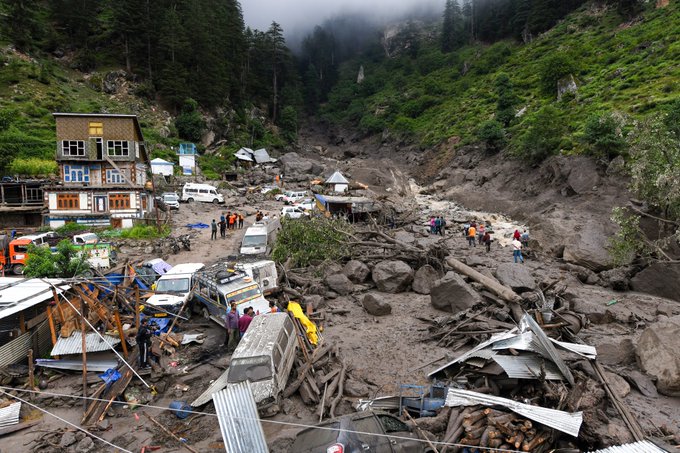
A massive flash flood, triggered by Thursday’s cloudburst, hit the remote mountain village of Chisoti in Kishtwar. Authorities have so far recovered 30 identified bodies, including two Central Industrial Security Force (CISF) personnel, and fear the toll may rise as many remain trapped.
In a post on X, the Prime Minister said he had spoken to Sinha and Abdullah and reviewed the situation. “Authorities are working on the ground to assist those affected,” he wrote.
Addressing an Independence Day event in Srinagar, Abdullah confirmed the scale of the tragedy. Officials said more than 160 people have been rescued so far, with 38 in serious condition. Sixty-nine others have been reported missing by families.
Search, Rescue, and Relief Efforts
A control room-cum-help desk has been set up in Paddar, 15 km from Chisoti, with five officials on duty and six helpline numbers issued. Pictures of victims are being circulated via WhatsApp for identification.
Two villages ahead of the affected zone — Machail and Hamori — remain cut off, with hundreds stranded and power supply snapped. Mobile phones in the area have run out of battery, making contact difficult.
The floods, accompanied by mudslides, destroyed 16 houses and government buildings, three temples, four water mills, a 30-metre bridge, and more than a dozen vehicles. A langar (community kitchen) for pilgrims and a security camp were washed away, while one temple miraculously survived.
Chisoti, the base camp for the annual Machail Mata Yatra, was crowded with pilgrims when the disaster struck between noon and 1 p.m. The pilgrimage, which began on July 25 and was to end on September 5, has been suspended for a second day.
Multi-Agency Operations
A National Disaster Response Force (NDRF) team reached Chisoti on Friday by road due to bad weather. Two more teams are on their way. The Army has deployed an additional column, bringing its total to five columns with 300 troops, supported by medical detachments of the White Knight Corps. Rashtriya Rifles, State Disaster Response Force (SDRF), police, and civilian agencies are also involved.
Volunteer groups, including Ababeel (with nine ambulances) and Hilal Volunteers, are helping evacuate the injured. Despite rain, rescue work resumed early Friday, aided by earthmovers clearing boulders, uprooted trees, and electricity poles.
Videos from the site show torrents of muddy water tearing through steep slopes, collapsing houses, and blocking roads with debris.
Medical Preparedness
The Jammu and Kashmir health department has reinforced facilities near the disaster zone, deploying 13 doctors and 31 paramedics to a sub-district hospital, and bolstering staff at Kishtwar district hospital with surgeons and anaesthetists from Doda.
Specialist teams from PGI-Chandigarh are en route to GMC-Jammu, which has prepared 50 disaster beds, 20 ventilator beds, and five operating theatres. More than 200 blood units are on standby.
In total, 65 ambulances from multiple agencies, including the Army, CRPF, NHPC, and J&K’s 108 Emergency Service, have been deployed for patient transport and rescue.
Authorities continue to warn that the number of casualties may rise as search operations progress in the mud- and debris-filled areas.