







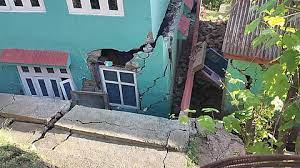
Jammu villages face Joshimath-like land subsidence crisis; over 3,000 displaced
Tangar: Families living in the majestic Pir Panjal and Shivalik ranges of Jammu, once confident their mountains would protect them, are now abandoning their homes as villages begin to “sink” under land subsidence triggered by heavy rains.
Since September 5, eleven villages across Ramban, Reasi, Jammu, and Poonch have reported cracks in houses, collapsing fields, and mass evacuations—drawing parallels with Uttarakhand’s Joshimath crisis. Officials confirmed that more than 3,000 people have been forced to leave their homes.
In Ramban district’s Tangar village, near the Sawalakot hydel project, 22–25 houses and a government high school have already been damaged, while another 140 houses spread over a 4-km area are at risk.
“It was a bolt from the blue,” said Ravi Kumar, a local resident. “First we faced cloudbursts, floods, and landslides. Then cracks appeared in our homes. Now most houses are unsafe.” His family now lives in a tent, bracing for winter.
Anil Kumar, who moved into his new home in January 2024, said he has no option but to leave. “It was built with my life’s savings. Now cracks are widening every day, and it can collapse anytime,” he said.
Sunil Kumar, an engineer from the area, warned that Tangar and nearby villages are witnessing the same subsidence pattern first seen in Joshimath.
Authorities, including Ramban MLA Arjun Singh Raju and Deputy Commissioner Iliyas Khan, inspected the area. Khan confirmed that schools have been shut and displaced families are being sheltered in NHPC quarters.
The crisis isn’t new. Ramban’s Pernote village collapsed in April 2024, damaging 58 homes and displacing 500 people. Earlier, Sangaldan also saw similar subsidence. Now, entire belts of Pir Panjal and Shivalik ranges—including Kalaban in Poonch, Khari, Rah Salyote, Barimini in Jammu, Sarh and Jamslan in Reasi, Panjnara and Badhaal in Rajouri, Piyas in Kishtwar, and Jamoda in Samba—are at risk.
Kalaban, near the LoC in Mendhar, sank on September 11, affecting over 1,000 people and damaging nearly 100 houses, a mosque, and a graveyard. Rafeeq Ahmed, a villager, said: “Our homes are buried. The river dried up, and we believe that’s why the land is collapsing.”
Joint teams of the Army, SDRF, and police evacuated 700 families, providing tents and ration supplies. Many residents blame poor planning and ecological neglect. “Roads here have no drainage in fragile hills. Only God can save us now,” said Rafeeq, who now lives in a tent with six family members.
Another resident, Bano Begum, described the disaster as “catastrophic.” She said, “Nearly 100 houses and 1,000 kanals of land have sunk, along with a perennial spring that once sustained us.”
Displaced families are demanding relocation and safer plots. “We cannot live in constant terror, wondering if the land will swallow us,” said Yasir, a labourer.
Minister Javed Rana, who visited the area on Sunday, said the government has ordered immediate relief, temporary shelters, and plans for permanent rehabilitation.
In Reasi’s Sarh and Jamslan, 70 houses were damaged. DC Nidhi Malik confirmed all affected families were moved to relief camps. “Cracks appeared slowly, but within a night the ground sank three to four feet, collapsing homes,” recalled Shamsher Din of Jamslan.
Officials said geological and mining experts are being roped in to investigate the causes. Roads have caved in, farmlands have been destroyed, and connectivity remains badly hit.